
Best Hikes at Sleeping Bear Dunes: 7 Trails Worth Your Time (2026)
Last Updated: April 2026
Hiking at Sleeping Bear Dunes National Lakeshore is one of the best things you can do in northern Michigan — and the trail options are far more varied than most visitors expect. Beyond the Dune Climb, there are 13 maintained mainland trails ranging from a 1.5-mile bluff walk to a 9-mile forest loop system, each with a completely different character. This guide covers the seven best, organized by difficulty, so you can pick the right hike for your group.
📌 Before You Hike: What to Know
- Park pass required for all trails: $25/vehicle 7-day · $45 annual. Buy at recreation.gov or at the Philip A. Hart Visitor Center in Empire. Michigan Recreation Passport is NOT valid here.
- No dogs on any trail in Sleeping Bear Dunes National Lakeshore
- No mountain bikes on any NPS trail — bikes are permitted on the Sleeping Bear Heritage Trail only
- Stay on designated trails. The park sits on an active erosion zone — off-trail hiking accelerates dune loss and damages fragile ecosystems
- Cell service is unreliable at Pyramid Point and parts of Alligator Hill — download maps before you go
- Bring water. No water sources on most trails. Sandy sections retain heat in summer — more water than you think you need is the right amount
- ADA access: The park offers All-Terrain Track Wheelchairs for trails not normally accessible. Info at nps.gov/slbe/accessibility
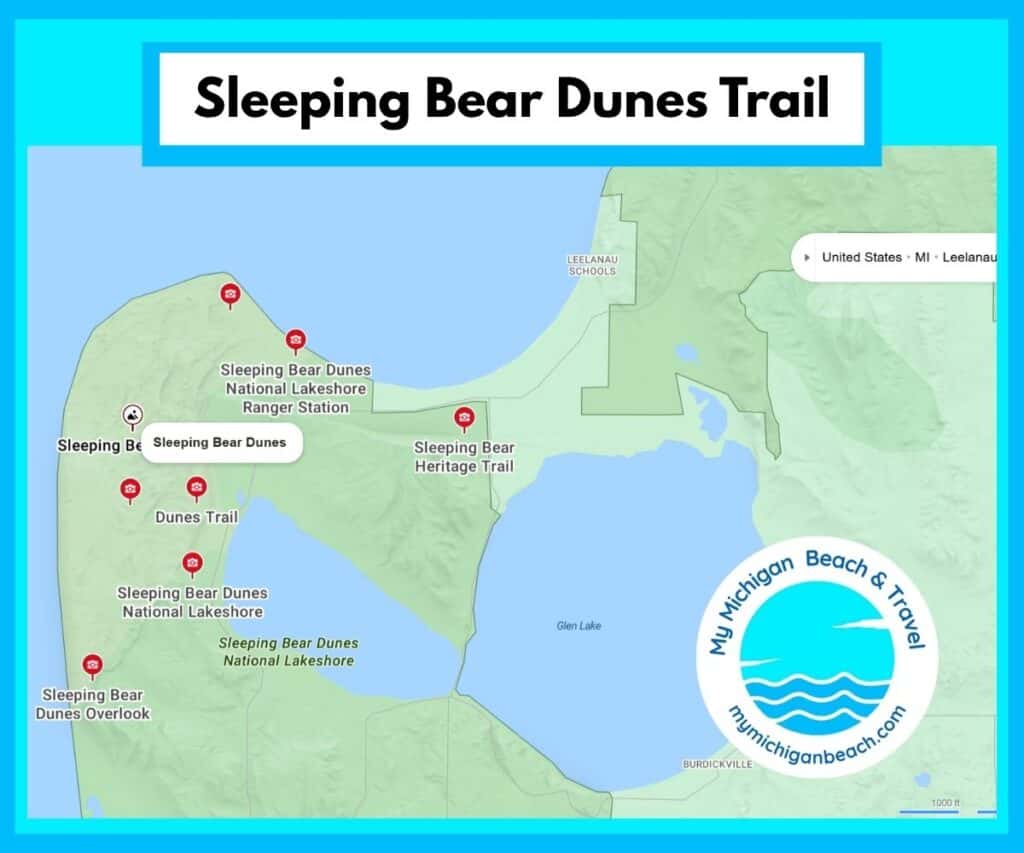
The 7 Best Hikes at Sleeping Bear Dunes
1. Empire Bluff Trail — Best Overall Short Hike
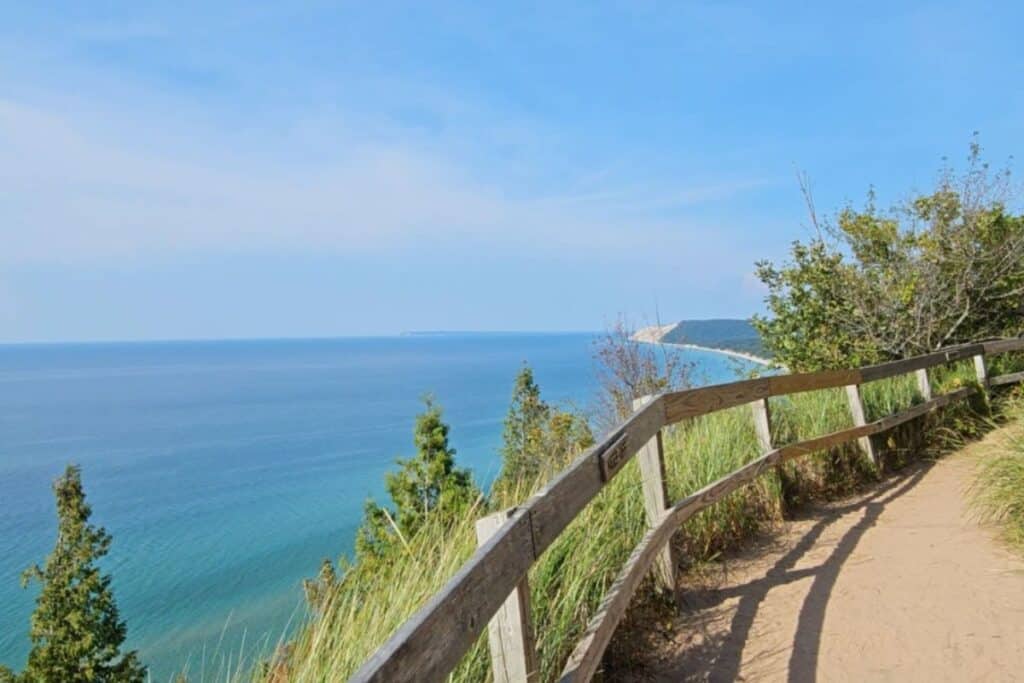
Empire Bluff Trail is the highest-rated hike in the park on AllTrails (4.8 stars, 4,000+ reviews) and it earns that rating. A 1.7-mile out-and-back through beech-maple forest ends at a wooden boardwalk on a bluff more than 400 feet above Lake Michigan — from here you can see South Bar Lake directly below, the sweep of Platte Bay to the south, the Sleeping Bear dune face to the north, and South Manitou Island on the horizon. On a clear day your view extends 25 miles in any direction. The trail passes abandoned historic farm implements about 0.1 miles in — remnants of the farmland that predated the national lakeshore. Six interpretive posts explain the geology and natural history along the way.
The trailhead parking lot is small and fills quickly on summer weekends — arrive before 9 AM or after 4 PM. The trail was rerouted slightly in 2022 to soften the final climb. Watch for poison ivy in the open sections. Do not descend the bluff face.
- 📍 Wilco Rd, Empire, MI 49630 — take Wilco Rd off M-22, about 1.7 miles south of Empire
- 📏 1.7 miles out-and-back · 180 ft elevation gain · 30–60 minutes
- ⭐ Difficulty: Moderate
- 🚻 Vault toilet at trailhead · small picnic area
- 🐾 Leashed pets allowed on this trail (one of few in the park)
- ❄️ Open year-round — excellent snowshoe trail in winter
2. Pyramid Point Trail — Best for the View
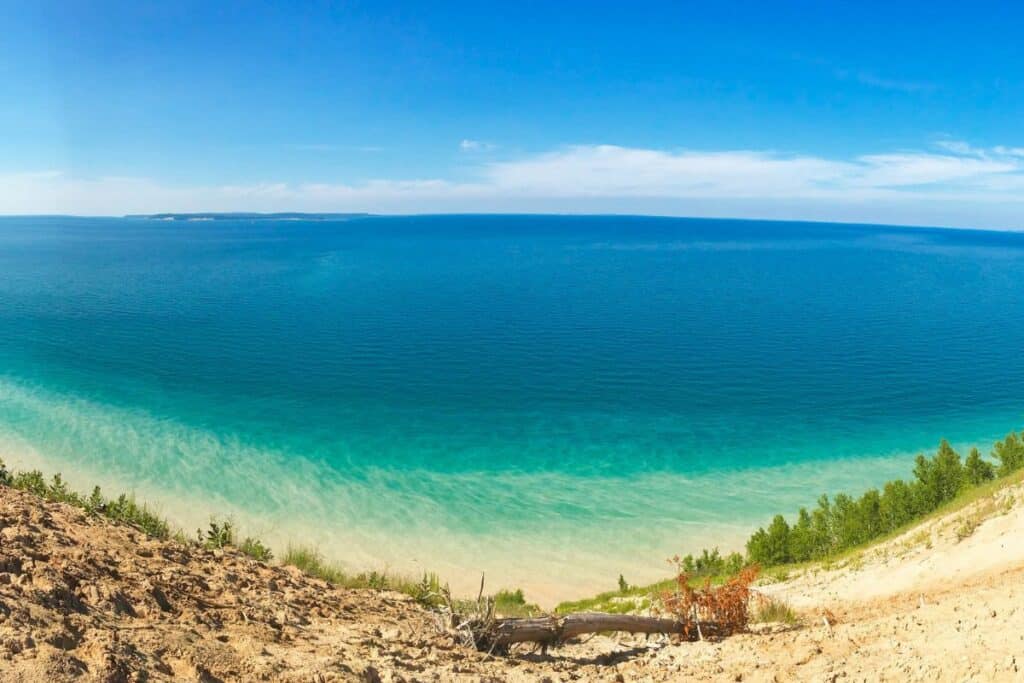
The full loop at Pyramid Point is one of the most rewarding hikes in the park — and most visitors only do the easier half of it. The 1.2-mile out-and-back to the overlook is worth doing on its own: a short steep climb through northern hardwood forest to a 300-foot bluff above Lake Michigan, with the Manitou Islands five miles offshore. But the full 2.7-mile loop that continues east through century-old beech-maple forest is seriously underrated — it adds rolling dune sections with more lake views and sees almost no traffic even in peak season. Total elevation gain for the full loop is around 550 feet. Budget 1.5–2 hours.
One rule worth taking seriously: do not descend the bluff face. It’s much farther down than it looks from the top and the sand is nearly vertical. Hikers require rescue here every season.
- 📍 Basch Rd, Maple City, MI 49664 — take Port Oneida Rd north from M-22 (3.7 miles north of Glen Arbor), follow to Basch Rd
- 📏 1.2 miles out-and-back to overlook · 2.7-mile full loop · 250–550 ft elevation gain
- ⭐ Difficulty: Moderate
- 🚻 Vault toilet at trailhead parking lot
- 📵 Cell service unreliable — download maps before you go
3. Alligator Hill Trail — Best for a Full Day Hike
Alligator Hill is the most undervisited major trail in the park and the best choice if you want a genuine workout with serious views. The trail system has 9 miles divided into three interconnected loops — Easy (2.7 miles), Intermediate (4.9 miles), and Advanced (9 miles) — all winding through beech-maple forest and hilly terrain between Lake Michigan and Big Glen Lake. The Islands Lookout at the top has panoramic views of Lake Michigan and the Manitou Islands; a 0.8-mile spur from there leads to the Big Glen Lake Lookout.
Two details that make Alligator Hill interesting beyond the views: the charcoal kiln at the trailhead is a remnant of the logging era — slabs of wood were sealed inside and burned slowly to produce charcoal sold commercially. And the north side of the hill has the overgrown outlines of an 18-hole golf course from the 1920s, built by lumber baron David Henry Day as part of an elaborate resort that failed during the Great Depression. It’s the only trail in the park open to horses, and the best cross-country ski trail in winter.
- 📍 Stocking Rd, Empire, MI 49630 — off M-109, 1 mile north of the Dune Climb
- 📏 2.7 miles (Easy) · 4.9 miles (Intermediate) · 9 miles (Advanced)
- ⭐ Difficulty: Easy to Advanced depending on loop
- 🚻 Accessible vault toilet at trailhead · no water on trail
- 🐴 Horses permitted — only trail in the park open to equestrians
4. Cottonwood Trail — Best for a Dune Walk
Cottonwood is the trail most people skip on Pierce Stocking Scenic Drive — and it shouldn’t be skipped. Accessed at Stop 4 on the drive, the 1.5-mile loop winds through perched dunes on the Sleeping Bear Plateau, more than 400 feet above Lake Michigan. The sandy terrain makes it feel harder than the mileage suggests, but the payoff is a combination of views you don’t get anywhere else in the park: the Dune Climb and its ant-like summer crowds below you, Glen Lake in one direction, Lake Michigan in the other, and the historic D.H. Day barn white against the green valley below. Nine interpretive posts explain the dune plant communities — bearberry, buffaloberry, beachgrass, cottonwoods — and why these shifting sands are both so special and so fragile. Pick up the self-guided brochure at the trailhead.
- 📍 Pierce Stocking Scenic Drive, Stop 4 — enter off M-109, about 3.5 miles north of Empire
- 📏 1.5-mile loop · 177 ft elevation gain · 30–60 minutes
- ⭐ Difficulty: Moderate (soft sand makes it harder than distance suggests)
- 🚻 Flush toilet and drinking water at nearby Picnic Mountain stop
- ⚠️ Pierce Stocking Scenic Drive closes to vehicles late October/early November — confirm dates at nps.gov/slbe
5. Good Harbor Bay Trail — Best Easy Hike
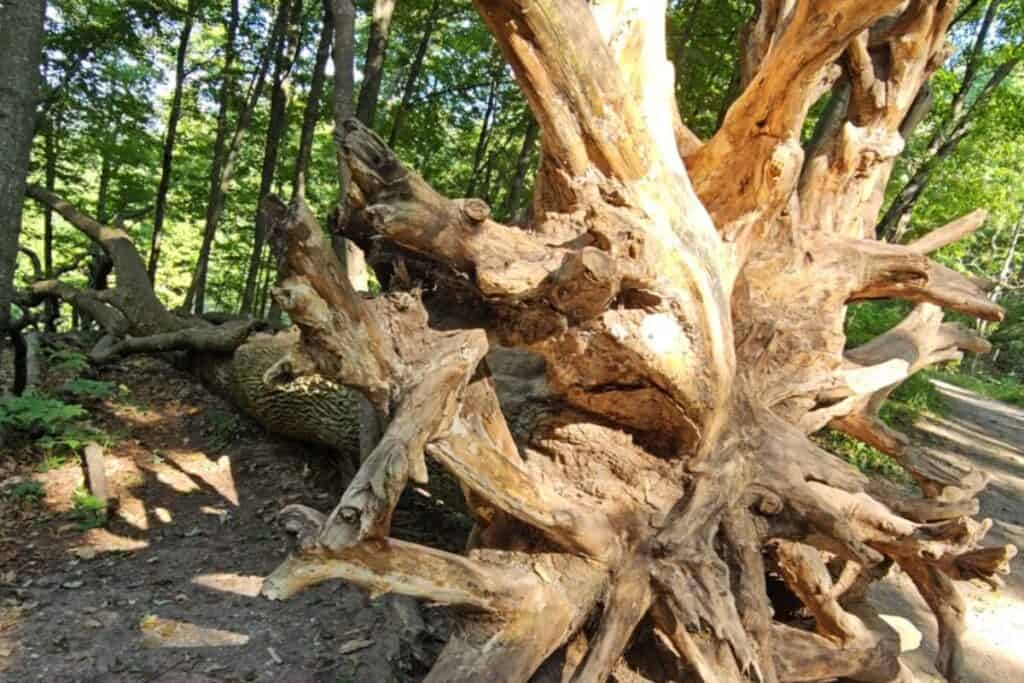
If your group includes young kids, anyone who doesn’t want significant elevation, or you want a peaceful morning walk before a beach day, Good Harbor Bay Trail in Glen Arbor is the right choice. The 2.8-mile loop is almost entirely flat — a brief section of low coastal dunes near the start accesses the beach, then the trail turns inland through a mix of shrubby dunes, lowland forest, and wetlands (small footbridges cross the wet sections). The ecological story here is one of the most interesting in the park: this entire area was submerged at the end of the Ice Age and has gradually emerged during the post-glacial period. The plant zones you walk through — active dunes to shrubs to pine-oak to early beech-maple — represent thousands of years of succession compressed into a 2.8-mile walk.
The trailhead puts you a short walk from Good Harbor Bay Beach, one of the best and least-crowded beaches in the park. Pair them for a half-day outing.
- 📍 Lake Michigan Rd, near Good Harbor Bay Beach — accessed from County Rd 669 north of Glen Arbor
- 📏 2.8-mile loop · nearly flat · 1–1.5 hours
- ⭐ Difficulty: Easy
- 👨👩👧 Best family-friendly hike in the park
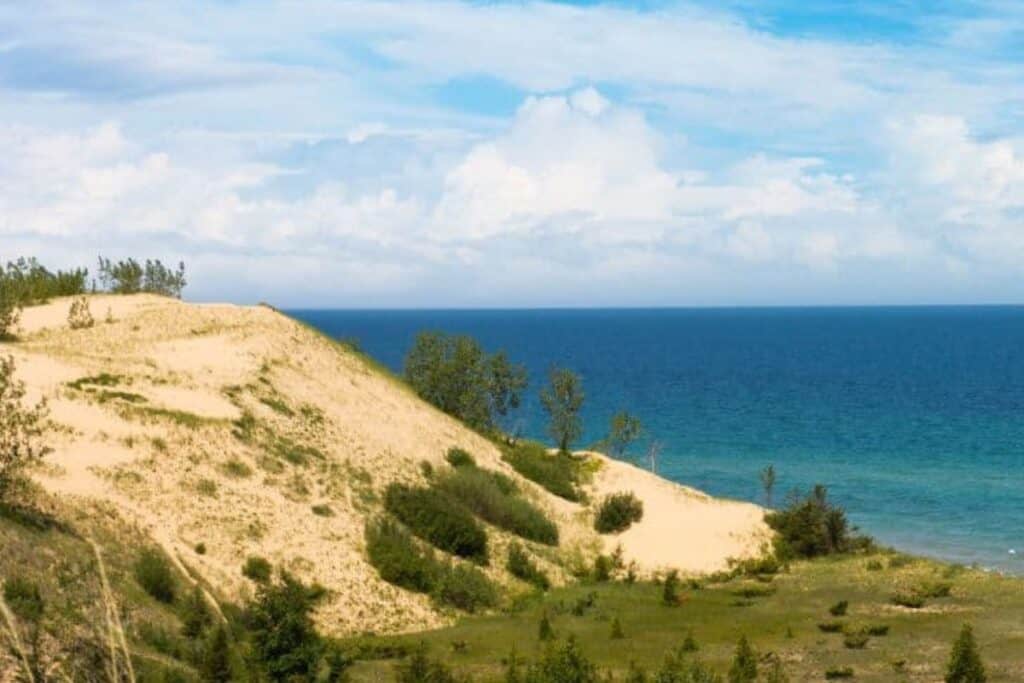
6. Sleeping Bear Point Trail — Best for Dune Landscape
Sleeping Bear Point Trail is a 2.8-mile loop through open dunes, ghost forest, and shifting sand that starts near Glen Haven Village and covers the most dramatic dune landscape of any maintained trail in the park. The contrast here is unlike anything else at Sleeping Bear: open white sand, bleached ghost forest trees, dune grass, and then the deep blue of Lake Michigan and Manitou Passage beyond. Blue-tipped trail markers keep you oriented in sections where the terrain offers no obvious path. The trail is mostly sand throughout — expect it to feel harder than 2.8 miles. Bring water and sun protection.
The starting point near Glen Haven also gives you a reason to visit the restored historic village — the Glen Haven General Store and Maritime Museum are both within walking distance of the trailhead.
- 📍 Sleeping Bear Dr, Glen Haven — 5 minutes west of Glen Arbor off M-109
- 📏 2.8-mile loop · mostly sand · 1.5–2 hours
- ⭐ Difficulty: Moderate-Strenuous (sand hiking requires more effort than distance suggests)
- ☀️ No shade — sun protection essential in summer
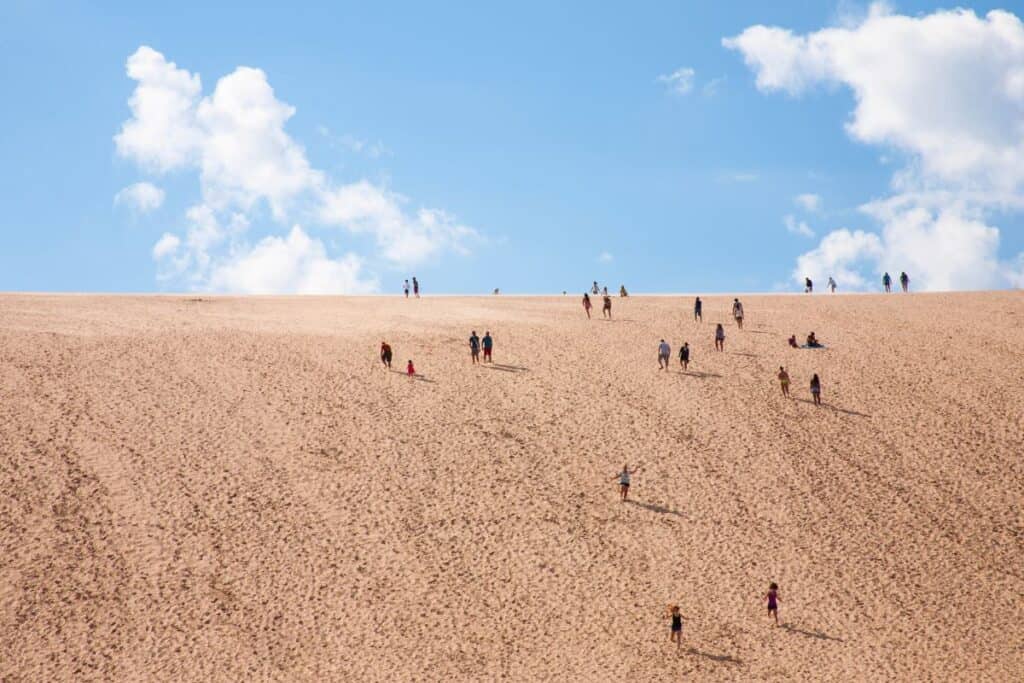
7. The Dune Climb — Most Iconic Experience
The Dune Climb is not technically a maintained hiking trail — it’s an open dune face you climb and descend freely. But no hike guide for Sleeping Bear Dunes is complete without it. The climb to the top of the first dune is about 300 feet of loose sand — steep enough that most adults are breathing hard by the top, and kids treat it as a race. The view back toward Glen Lake from the crest is worth the effort on its own. If you continue past the first crest, you face 5 more dunes before reaching Lake Michigan — 3.8 miles round trip total with significant exertion in deep sand and full sun. Rescues happen here every season when people underestimate the return trip. Every rescue costs the rescued party thousands of dollars.
⚠️ If you hike beyond the first dune crest toward Lake Michigan: bring at least 1 liter of water per person, proper shoes (not sandals), sunscreen, and a realistic assessment of your fitness. The return climb is harder than the descent. Do not attempt with young children in summer heat.
- 📍 Dune Climb parking lot, M-109, Empire, MI — 4 miles north of Empire
- 📏 First crest and back: ~0.5 miles · Full to Lake Michigan and back: 3.8 miles
- ⭐ Difficulty: Strenuous (full hike to lake) · Moderate (first crest only)
- 🚻 Restrooms and water at the Dune Climb parking lot
- 🚲 Sleeping Bear Heritage Trail accessible from this parking lot
Which Hike Is Right for You?
Here’s a quick way to choose:
- Best short hike with the best view: Empire Bluff Trail
- Best for serious hikers: Alligator Hill Advanced Loop or Pyramid Point full loop
- Best with young kids or low fitness level: Good Harbor Bay Trail
- Best for the classic dune experience: The Dune Climb (first crest only)
- Best interpretive/educational hike: Cottonwood Trail
- Best for open dune landscape: Sleeping Bear Point Trail
- Best fall color hike: Pyramid Point full loop or Alligator Hill — see the full Sleeping Bear Dunes fall guide
Frequently Asked Questions
Empire Bluff Trail is the highest-rated hike in the park — a 1.7-mile out-and-back to a boardwalk overlook 400+ feet above Lake Michigan near Empire. For a longer challenge, the Pyramid Point full loop (2.7 miles) and Alligator Hill (up to 9 miles) are the best options for experienced hikers.
No — dogs are not permitted on any trail in Sleeping Bear Dunes National Lakeshore. The exception is Empire Bluff Trail, where leashed pets are allowed. Dogs are also permitted on leash at some park beaches including Miners Beach and Sand Point — confirm current rules at nps.gov/slbe.
Yes — a park entrance pass is required for all trail use. A 7-day vehicle pass costs $25; an annual Sleeping Bear Dunes pass is $45. The Michigan Recreation Passport is not valid here — this is a federally managed National Lakeshore. Buy passes at recreation.gov, the Philip A. Hart Visitor Center in Empire, or at trailhead self-pay stations.
The climb to the first crest is strenuous — about 300 feet of loose sand at a steep grade. Most adults are winded by the top. If you hike all the way to Lake Michigan and back (3.8 miles round trip), the return climb is demanding enough that rescues happen regularly. Bring substantial water, proper shoes, and sun protection for the full hike.
More Sleeping Bear Dunes Guides
- Sleeping Bear Dunes Complete Visitor Guide
- Pyramid Point Trail: Full Guide
- Sleeping Bear Dunes in Fall
- Sleeping Bear Dunes Camping Guide
- Sleeping Bear Dunes Overlook — what changed in 2025
- Pierce Stocking Scenic Drive Guide
- About Jill
- Recent Michigan Travel Tips

Jill Halpin is a Michigan travel expert and founder of MyMichiganBeach.com. She has been sourced by The Washington Post and featured in The Detroit News and Detroit Free Press, and appears regularly on WDIV Detroit, FOX 2 Detroit, FOX 17 West Michigan, FOX 32 Chicago, WGN Chicago, and NewsNation — 60+ television appearances to date. She holds an MLIS from Wayne State University and is a Library of Congress Information Science Fellow. See all media features.