
Black Rocks Marquette Cliff Jumping Info (UPDATED)
Last Updated: June 2026
Black Rocks Marquette is the name locals use for a stretch of 20-to-30-foot ancient volcanic cliffs at Presque Isle Park, where Lake Superior throws itself against 1.7-billion-year-old peridotite and Northern Michigan University students have been jumping in for decades. The water is genuinely cold — closer to 38°F than the postcard version — and that’s part of the whole point.
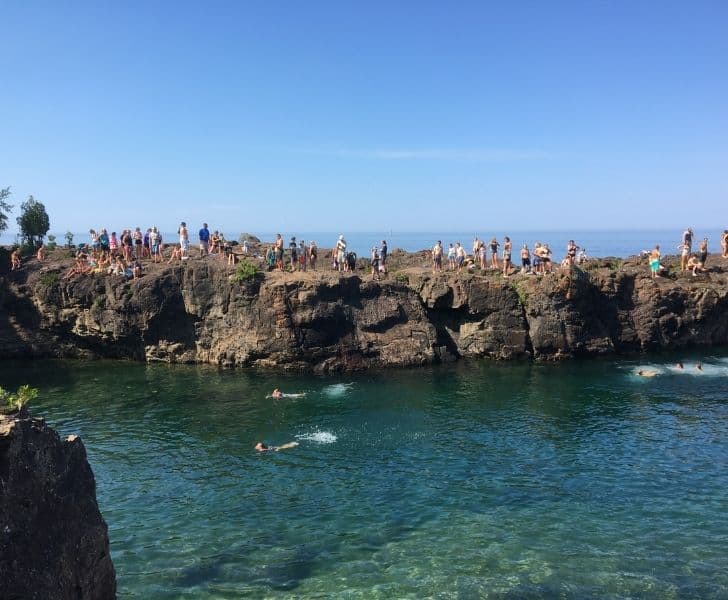
I’ve stood on top of Black Rocks in three seasons now and watched people of every age either count themselves up to a jump or quietly back away from the edge — both responses are reasonable. This guide covers what you actually need to know: where to park, how high the jump really is, what the City of Marquette officially says about safety, why your dog has to stay in the car, and the one piece of geology that makes this place stranger than it looks.
📍 At a Glance: Black Rocks Marquette
- 📏 Cliff height: 20-30 feet (varies with Lake Superior water levels)
- 🪨 Geology: 1.7-billion-year-old metamorphosed igneous peridotite
- 📍 Where: Presque Isle Park, 3 Peter White Drive, Marquette, MI 49855
- 💰 Cost: Free — no admission, no parking fee
- 🌊 Water depth: ~20-30 feet near the cliffs (deepest spots safest for jumpers)
- 🥶 Water temp: Roughly 38°F year-round — Lake Superior never warms up much
- 🚫 Dogs: NOT allowed in Presque Isle Park outside of an enclosed vehicle (city ordinance)
- 🚗 Drive from downtown Marquette: ~3 miles north via Lake Shore Boulevard
Where Is Black Rocks Marquette?
Black Rocks is located on the western edge of Presque Isle Park, a 323-acre forested peninsula that juts into Lake Superior just north of downtown Marquette. From downtown, follow Lake Shore Boulevard north for about 3 miles past the ore docks — the park entrance is at the end of the road. Park in the small lot near the cliffs (just off Peter White Drive on the west side of the loop), and a short footpath drops you straight into the cove.
The park itself is set on a peninsula surrounded on three sides by Lake Superior. Peter White Drive, the loop road around the perimeter, is closed to motor vehicles seasonally during morning and evening hours to make space for walkers and bikers — check posted hours when you arrive. The park is open daily 7 AM to 11 PM in summer and fall (7 AM to 8 PM in winter, with the road closed to vehicles entirely from Nov 1 through spring).

What Are the Black Rocks?
The Black Rocks are a rugged outcropping of metamorphosed igneous peridotite — about 1.7 billion years old — that has been exposed where the surrounding Jacobsville Sandstone has eroded away. The dark, almost charcoal-colored rock against the blue of Lake Superior is what gives this stretch of shoreline its name and most of its photogenic appeal. Geologists call the way the older peridotite sits beneath the much younger sandstone a nonconformity; you can see the same exposure on the west side of Presque Isle Park.
The cliffs rise 20 to 30 feet above the water depending on Lake Superior’s level that season. The pebbly beach in the cove between the two main cliff faces is a known spot for rock hunting, including Yooperlites after dark with a UV light, and you might get lucky with smaller polished Lake Superior agates. Petoskey stones are far more common down in the Lower Peninsula along Lake Michigan, but I won’t pretend you can’t get lucky here.

Is Black Rocks Marquette Worth Visiting?
Yes — even if you have no intention of jumping. The view from the top of the cliffs is one of the three best Lake Superior overlooks in the Marquette area, alongside Sugarloaf Mountain and Hogback Mountain. The combination of black rock, blue water, and the hardwood forest behind you is genuinely striking, and the short walk from the parking lot makes it accessible to anyone willing to navigate uneven volcanic terrain. Plan to spend 30-60 minutes if you’re sightseeing, or 1-2 hours if you’re swimming and jumping.
The honest caveat: this is volcanic rock, and it’s hard, sharp, and slippery when wet. Wear water shoes or sturdy sandals. The most common Black Rocks injuries aren’t from jumping — they’re from twisted ankles on the rocks themselves.
Cliff Jumping at Black Rocks: What Officials Actually Say
Cliff jumping at Black Rocks is a long-running, unofficial Marquette tradition — and it’s legal, unlike at Pictured Rocks National Lakeshore, where jumping from any cliff over 15 feet is prohibited. The City of Marquette Fire and Rescue Department does not encourage jumping. A department official has described it to the press as a high-hazard activity: the area isn’t guarded, the lake has rip currents, the water is cold, and you swim at your own risk.
That said, Marquette officials acknowledge the practice is deeply ingrained. Fire Chief Tom Belt has said that in nearly two decades with the department he recalls two deaths and about a half-dozen injuries at the rocks, and that police patrol the area when it’s busy. Of the two deaths, one was a slip-and-fall onto the rocks and the other was a nighttime incident in heavy, fast-moving water — neither was a conventional cliff-jumping injury. The real risks are the water temperature, the rip currents, and the rocks themselves, not the height.
💡 PRO TIP: Locals consistently recommend swimming up to the rocks first and climbing from the water rather than walking straight to the top from the parking lot. This forces you to acclimate to the water temperature before you commit, and it’s how you’ll see most experienced jumpers do it. If the water shocks you that much from the swim, you have your answer about whether to jump.
Cliff Jumping Safety: Read This First
If you’re going to jump, the Marquette officials’ standing advice is consistent: go with at least one other person, never go at night, never dive headfirst, and always look before you leap. A few specifics that matter more than most blog posts admit:
- Find the deepest water. The deepest pool — usually visible as the darkest blue from above — is the safest landing zone. Jumping over shallower water is what causes most rock-strike injuries.
- Check water levels before you jump. Lake Superior’s level varies seasonally and year to year. A safe spot in July may be too shallow in October.
- Don’t jump if the lake is rough. Wave action makes climb-outs dangerous and shifts where you’ll actually land.
- Confident swimmers only. The cold causes “cold water shock” — gasping, hyperventilation, and grip strength loss — within seconds of impact. Younger kids should watch from shore or wade in the cove.
- Wear water shoes for the rocks, not the jump. Most jumpers don’t jump in shoes, but you’ll need them for walking the volcanic terrain.

Best Time to Visit Black Rocks
The best time to visit Black Rocks for jumping is July through early September on a calm, sunny weekday, when air temperatures are warm enough to make the cold-water shock survivable and the parking lot doesn’t fill before noon. Weekends in peak summer the lot fills early and you’ll do a short walk in. For sightseeing without the crowds, late September through mid-October is genuinely my favorite — the maples behind the cliffs turn brilliant red, the lake is still ice-free, and you’ll often have the whole overlook to yourself.
Winter at Black Rocks is its own thing: “pancake ice” forms in the cove during deep cold, the trees get coated by lake-effect spray, and the cliffs become a quiet, ice-blasted landscape. The road around Presque Isle Park closes to motor vehicles November 1 through mid-spring, so you’ll walk or bike in. It’s free, it’s exposed, and it is unforgettable on the right February day.
Dogs and Accessibility at Black Rocks
This is the single most important piece of information that most Black Rocks guides skip: dogs are NOT allowed in Presque Isle Park outside of an enclosed vehicle. Per City of Marquette ordinance, the park is a designated nature preserve, and Travel Marquette’s official dog-friendly guide confirms the rule. Service animals are exempt. First-time visitors typically get a warning rather than a citation, but you’ll genuinely have a better day if you leave the dog at home or at a dog-friendly trail.
If you’re traveling with a dog, the area along County Road 550 has plenty of leashed-dog-friendly trails (Sugarloaf Mountain, Thomas Rock, the Iron Ore Heritage Trail), and Tourist Park Campground operates as a seasonal off-leash dog park from Nov 1 through April 30 with a small license fee. For accessibility: Presque Isle Park itself has paved roads and viewing pull-offs that are wheelchair-accessible, but the descent to the Black Rocks beach and cliffs is over uneven volcanic rock and is not ADA-accessible. Sunset Point and the East Bluff overlook are both reachable by car for those who want the Lake Superior view without the climb.
- 📍 Address: Presque Isle Park, 3 Peter White Drive, Marquette, MI 49855 | Travel Marquette page
- ⏰ Hours: Park open 7 AM – 11 PM (summer/fall); 7 AM – 8 PM (winter)
- 💰 Cost: Free admission and parking
- 🚫 Dogs: NOT permitted outside of vehicles per City of Marquette ordinance (service animals exempt)
- ♿ Accessibility: Park roads and Sunset Point pull-offs are car-accessible; cliff/beach descent is not ADA-accessible

More to Do in Presque Isle Park
Black Rocks is the headline attraction, but Presque Isle Park earns the full afternoon. The 2-mile Peter White Drive loop circles the peninsula with viewpoints, picnic areas, and beach access along the way. Sunset Point on the west side is the genuine spot for a Lake Superior sunset. The east side has a high sandstone-cliff overlook and the harbor breakwater. The Bog Walk is a short interpretive boardwalk through wetland habitat with bird-watching benches and information signs about peregrine falcons that nest in the area.
Don’t skip the road’s car-free hours: Peter White Drive closes to motor traffic Mon/Wed evenings and Tue/Thu/Sat/Sun mornings in summer, which is when the bike loop is at its best.

Where to Eat Near Black Rocks
After a swim and climb, Marquette has the food side covered. Blackrocks Brewery on Third Street is the obvious — and correctly named — choice; their flagship 51K IPA pairs perfectly with a Lake Superior afternoon. Iron Bay Restaurant and Distillery downtown serves Lake Superior whitefish, hand-cut steaks, and an actually-good cocktail program in a historic building. For coffee before you head to the rocks, Contrast Coffee Co. on Washington Street roasts beans in Iron River, MI, and serves crepes and panini if you need food. Note: per Travel Marquette’s guidance, many Marquette County restaurants and breweries do not allow dogs, including most patios — plan accordingly.

Where to Stay in Marquette
Marquette has the best lodging variety in the U.P. — character hotels, reliable chains, and lakefront vacation rentals. A few I send people to:
- Landmark Inn — historic downtown character, walking distance to restaurants
- Hampton Inn Marquette Waterfront — reliable, on the water, easy parking
- Staybridge Suites — extended-stay option with kitchenettes
- Holiday Inn Marquette — solid mid-range chain off US-41
- Ramada Inn by Wyndham — affordable, off-highway

Black Rocks Marquette FAQ
What are the Black Rock Cliffs in Marquette made of?
The Black Rocks are metamorphosed igneous peridotite about 1.7 billion years old. The rock was previously buried beneath Jacobsville Sandstone, which sits directly on top of that ancient erosional surface — geologists call this contact a nonconformity.
How deep is the water at Black Rocks Marquette?
Lake Superior is approximately 20-30 feet deep at the base of the Black Rocks cliffs, with the deepest pools (visible as the darkest blue from above) being the safest landing zones for jumpers.
Can you cliff jump at Black Rocks in Marquette?
Yes, but at your own risk. Cliff jumping at Black Rocks is legal and a long-running local tradition, but the City of Marquette Fire and Rescue Department does not recommend it, citing Lake Superior’s cold water temperatures (around 38°F year-round) and rip currents as the primary risk factors. There are no lifeguards. Go with a buddy, never at night, find the deepest water, and never dive headfirst.
How tall are the Black Rocks cliffs?
The cliffs rise approximately 20 to 30 feet above Lake Superior, depending on the lake’s seasonal water level. Most jumpers report jumps in the 20-25 foot range during typical summer conditions.
Are dogs allowed at Black Rocks or Presque Isle Park?
No. Per City of Marquette ordinance, dogs are not allowed in Presque Isle Park outside of an enclosed vehicle. The park is a designated nature preserve and the rule applies to all visitors. Service animals are exempt. Dog-friendly alternatives in the Marquette area include Sugarloaf Mountain, Thomas Rock, and the Iron Ore Heritage Trail.
Is there a fee to visit Black Rocks?
No. Black Rocks and Presque Isle Park are free to visit — there is no admission fee and no parking fee. The park is owned and operated by the City of Marquette.
Plan Your Black Rocks Visit
Black Rocks Marquette is the kind of place I think every UP visitor should see at least once — even if you watch the jumping from a safe perch with your camera. Park in the small lot off Peter White Drive, walk the short path down to the cove, decide for yourself whether to swim, and stick around for sunset at Sunset Point on the way out. Bring water shoes, leave the dog at home, and respect what 38°F water can do to your body in the first 30 seconds. The combination of geology, history, and the deepest, coldest of the Great Lakes is genuinely hard to find anywhere else in the Midwest.
More Lake Superior Cliffs and Marquette Travel
For a complete contrast to Black Rocks’ dark peridotite, head an hour east to Pictured Rocks National Lakeshore — sandstone cliffs in deep red, ochre, and green. Note that cliff jumping over 15 feet is illegal at Pictured Rocks, so save the leap for Black Rocks. Other quick drives from Marquette include Kitch-iti-Kipi, Michigan’s largest natural freshwater spring, and the Sugarloaf Mountain summit hike for the same Lake Superior view without the climb down to water.


- About Jill
- Recent Michigan Travel Tips

Jill Halpin is a Michigan travel expert and founder of MyMichiganBeach.com. She has been sourced by The Washington Post and featured in The Detroit News and Detroit Free Press, and appears regularly on WDIV Detroit, FOX 2 Detroit, FOX 17 West Michigan, FOX 32 Chicago, WGN Chicago, and NewsNation — 60+ television appearances to date. She holds an MLIS from Wayne State University and is a Library of Congress Information Science Fellow. See all media features.