
Northern Lights Michigan 2026: When, Where, and How to See the Aurora
Last Updated: September 2026
The northern lights in Michigan are more reachable than most people think, but seeing them in 2026 comes down to three things: a dark northern horizon, a place you can legally stand at 1 a.m., and knowing which number to watch once you get there. Most state parks close to day visitors at night, and the most famous overlook in the state is gated by snow for much of aurora season. Nine sites in Michigan let you pull in after dark and stay until dawn.

I spend a lot of summer nights trying to catch the northern lights, and I’ve gone chasing them at Headlands International Dark Sky Park near Mackinaw City. The first thing those nights taught me: your camera sees more than you do. A glimmer of color my eyes could barely register came out as a real glow on my phone, and that one lesson has changed how I watch the sky.
Below you’ll find where to go, which sites stay open all night and which get plowed in winter, how to read the forecast without overthinking it, and a live Michigan outlook built on NOAA data. Everything here is checked against the Michigan DNR, NOAA and each park’s own operator.
At a Glance: Northern Lights in Michigan
- Season: late August through early April, per the Michigan DNR, with the best odds around the September and March equinoxes
- Best hours: 10 p.m. to 2 a.m., though strong displays can start later
- Legal all-night sites: nine, including the six state dark sky preserves, Headlands, Keweenaw Dark Sky Park and Beaver Island’s sanctuary
- Kp you need: about 4 for the Upper Peninsula and the Straits, 5 for the northeast Lake Huron coast, 7 or higher for southern Michigan
- What decides the night: clear skies first, then a south-pointing Bz in the solar wind
- Darkest dates ahead: new moons on Oct. 10, Nov. 9 and Dec. 8, 2026, then Jan. 7, Feb. 6 and March 8, 2027
- Cost: a Recreation Passport for state parks; Headlands is a free county park
Michigan is one of the best aurora states in the Lower 48, and the reason is the water. The Great Lakes give you what inland states can’t: a flat, unlit horizon. Stand on the Lake Superior shore facing north and there’s nothing between you and Canada but dark water, which is why the Keweenaw outperforms spots at the same latitude in Minnesota and Wisconsin, and why the Lake Huron shore in the northeastern Lower Peninsula punches above its latitude.
The catch is that a dark horizon does you no good if the gate is shut, or if a wall of trees sits between you and the north. That second problem even applies at the most famous dark sky park in the state, and it’s the first thing I’d want you to know before you drive anywhere.
Quick Picks by Interest
- Best odds in Michigan: Keweenaw Dark Sky Park near Copper Harbor, with Lake Superior on three sides of the peninsula
- Easiest dark sky to reach: Headlands near Mackinaw City, free, open 24 hours and two miles from town
- Open northern horizon at the Straits: Wilderness State Park, nine miles west of Headlands
- Best in deep winter: Thompson’s Harbor State Park, a plowed preserve with two rustic cabins you can rent
- Closest to Detroit and Ann Arbor: Lake Hudson Recreation Area in Lenawee County
- Best accessible option: Headlands, with a paved one-mile trail to the viewing area and restrooms open around the clock
- With your dog: Rockport, Thompson’s Harbor and Negwegon, where leashed pets are allowed along the Lake Huron shoreline
Tonight’s Michigan Aurora Outlook
This live outlook pulls NOAA’s latest readings and translates them into what they mean for six Michigan regions, from the Keweenaw down to metro Detroit. It refreshes every few minutes while you have the page open.
Here’s how to read it. “Kp right now” is NOAA’s running estimate of geomagnetic activity. “Tonight’s peak Kp” is the highest value NOAA forecasts during tonight’s dark hours. Bz tells you whether the solar wind is pointing south, which is what lets the aurora switch on. Each region shows “Worth going” when the forecast meets the Kp that area usually needs, and “Camera may catch it” when it falls one step short, which is exactly the kind of night when a phone picks up color your eyes miss. It’s a guide, not a promise: clouds can erase a great forecast, and a quiet forecast can surprise you.
Michigan Aurora Outlook
Checking NOAA’s latest space weather readings for Michigan…
- Kp right now
- –
- Tonight’s peak Kp
- –
- Bz (solar wind)
- –
- Darkness
- –
Tonight by region, north to south
- Keweenaw and western UPKeweenaw Dark Sky Park, Copper HarborChecking…Needs about Kp 4+
- Lake Superior shoreMarquette, Pictured Rocks, Whitefish PointChecking…Needs about Kp 4+
- Straits of MackinacHeadlands, Wilderness State ParkChecking…Needs about Kp 4+
- Northeast Lake Huron coastThompson’s Harbor, Rockport, NegwegonChecking…Needs about Kp 5+
- Thumb and mid-MichiganPort Crescent State ParkChecking…Needs about Kp 6+
- Southern MichiganLake Hudson, metro DetroitChecking…Needs about Kp 7+
Data from the NOAA Space Weather Prediction Center. Kp is a rough planetary gauge, and clouds decide the night, so check your local forecast before you drive. For the live oval, open NOAA’s 30-minute aurora forecast.
Best Places to See the Northern Lights in Michigan
The best places to see the northern lights in Michigan share two things: a dark, open view to the north, usually over water, and legal access after dark. Nine sites meet both tests without a campsite reservation. The six state dark sky preserves stay open 24/7, according to the Michigan DNR’s dark sky page, and three more protected sites allow night visits.
| Site | Where | Night access |
|---|---|---|
| Keweenaw Dark Sky Park | Copper Harbor | 7 p.m. to 7 a.m., year-round |
| Headlands Dark Sky Park | Mackinaw City | 24/7, free |
| Wilderness State Park | Emmet County | 24/7; only the headquarters area is plowed |
| Thompson’s Harbor State Park | Presque Isle County | 24/7; plowed in winter |
| Rockport Recreation Area | Presque Isle and Alpena counties | 24/7; plowed in winter |
| Negwegon State Park | Alcona County | 24/7; no winter plowing |
| Port Crescent State Park | Huron County | 24/7; no winter plowing, hike in from the lot |
| Lake Hudson Recreation Area | Lenawee County | 24/7; closest to Detroit |
| Beaver Island Sanctuary | Charlevoix County | 24/7; ferry or plane only |
Pro tip: Dr. T.K. Lawless Park in Cass County is a certified International Dark Sky Park and shows up on every Michigan stargazing list, but it opens at night mainly for scheduled star-viewing events. Don’t drive there on an aurora alert without checking the Cass County Lawless Park page first.
The Keweenaw: Michigan’s Best Odds
The tip of the Keweenaw Peninsula sits near 47.5°N with Lake Superior on three sides, the highest-latitude, darkest-horizon ground in the state. You don’t drive up here on an alert; it’s roughly five hours past the Mackinac Bridge. You come for a few nights during a promising stretch and let the sky come to you.
Keweenaw Dark Sky Park is headquartered at the historic Keweenaw Mountain Lodge, 14252 US-41, just outside Copper Harbor. It’s open to the public from 7 p.m. to 7 a.m. year-round, and you don’t need to be a lodge guest. It’s the Upper Peninsula’s only International Dark Sky Park.
Brockway Mountain Drive, the 8.8-mile ridge road above Copper Harbor, is the most-recommended aurora overlook in Michigan, and for good reason. It’s also a seasonal road. The Keweenaw County Road Commission doesn’t plow it, so it closes to cars in winter and becomes a snowmobile route, typically reopening between mid-April and early May. If you’re planning a January trip around it, plan on the lodge grounds or the Copper Harbor shoreline instead.
The Lake Superior Shore, Marquette to Whitefish Point
The south shore of Lake Superior is one long, north-facing dark corridor that you can work as a drive. Marquette, Munising, AuTrain and Pictured Rocks National Lakeshore all sit along it. None of these is a designated dark sky site, so check the posted hours of any city park or pull-off before you settle in for the night.
Whitefish Point, about 11 miles north of Paradise, gives you the best photo composition on the Superior shore: open horizon, dark water and the oldest operating lighthouse on Lake Superior in the frame. The light is an active navigational beacon, so it will be turning while you shoot.
Porcupine Mountains Wilderness State Park and Tahquamenon Falls State Park both have near-zero light pollution, but neither is a dark sky preserve, so night access runs through a campsite. Book one and you’re standing outside your tent when the sky lights up instead of driving anywhere.
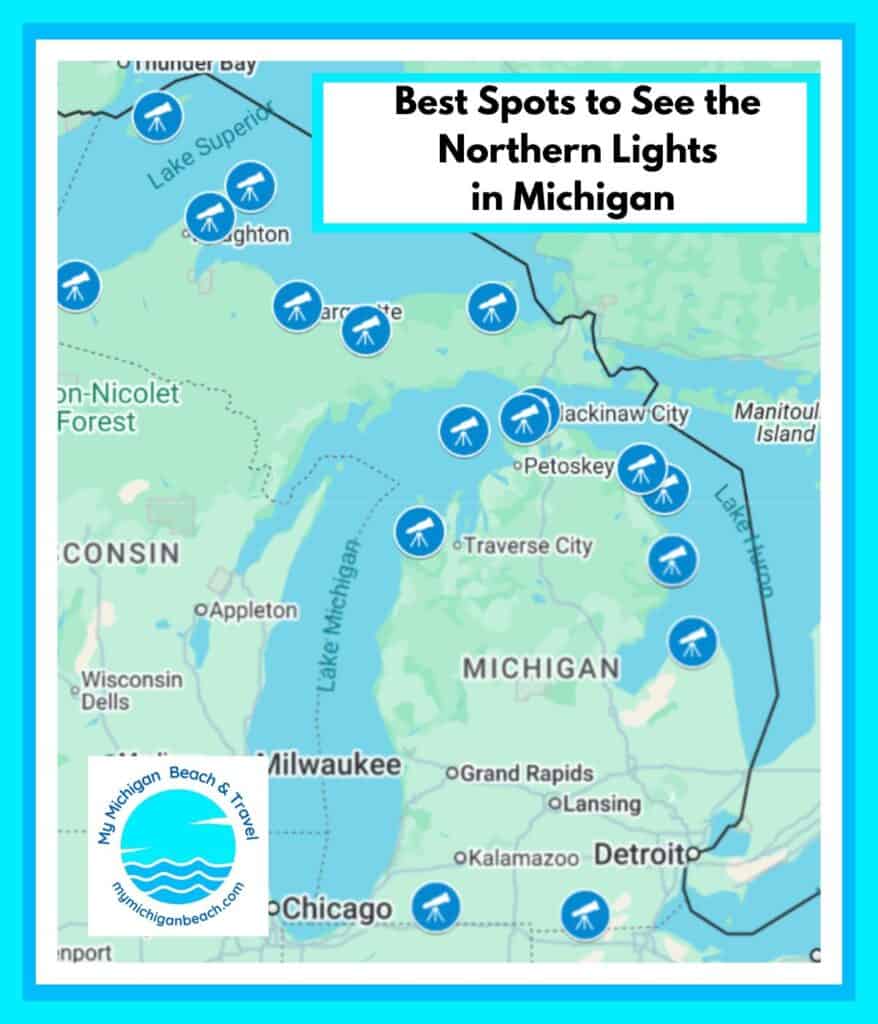
The Straits: Headlands and Wilderness, Nine Miles Apart
Headlands International Dark Sky Park, 15675 Headlands Road, two miles west of downtown Mackinaw City, is free and open 24 hours a day. It’s the easiest genuinely dark sky in the Lower Peninsula, and the park’s own staff say a Kp of 4 or higher usually does it at their latitude.
Here’s the part most guides skip. The Headlands team says its designated viewing area has no north-facing vantage point, so a low aurora near the horizon can be hidden by trees, even when visitors see the brighter show overhead. On a clear aurora night the parking lot fills early and it’s a one-mile walk to the viewing area, so the park recommends arriving before sunset. White flashlights and phone screens aren’t allowed in the viewing area; red-filtered lights are fine and are sold on site. The Headlands stargazing page lays out the park’s own aurora advice.
Wilderness State Park, nine miles west along the same shoreline, is also a 24-hour dark sky preserve, with 26 miles of Lake Michigan shoreline, campgrounds and rustic cabins. It gets a fraction of the traffic. Here’s what I’d do: scout Headlands in daylight, then keep Wilderness as your low-horizon option for the nights when the aurora hugs the north. The DNR plows only the area near park headquarters in winter.
The Lake Huron Coast: Four Preserves on One Shoreline
This is the stretch Michigan aurora guides miss, and it’s the one I’d point most Lower Peninsula readers toward. Four of the state’s six dark sky preserves sit on the Lake Huron coast, all open 24 hours. North to south: Thompson’s Harbor State Park, Rockport Recreation Area, Negwegon State Park and Port Crescent State Park at the tip of the Thumb.
The winter split is what to plan around. The DNR plows Rockport and Thompson’s Harbor; it doesn’t plow Negwegon or Port Crescent. Thompson’s Harbor, 24 miles north of Alpena on US-23, is my winter pick: more than 5,000 undeveloped acres, 7.5 miles of rocky shoreline and two rustic cabins you can rent, which means you can sleep inside a plowed, 24-hour preserve in January.
Rockport, just north of Alpena, is a 4,237-acre former limestone quarry with the easiest cold-weather access of the group. Negwegon is 4,000 acres of undeveloped park with eight miles of shoreline and four hike-in campsites from April through November, the darkest of the four and the closest thing to the UP without the drive. At Port Crescent, the DNR points stargazers to the viewing platform near Parking Lot D.
Can You See the Northern Lights from Detroit or Southern Michigan?
Yes, during strong storms. Metro Detroit sits near 42.3°N, so southern Michigan generally needs Kp 7 or higher, and Kp 8 or more to punch through city light. That’s why the May 10 to 11, 2024 storm, the first G5 since 2003, was such a big deal: it put aurora over the whole state, Detroit and Ann Arbor suburbs included.
Lake Hudson Recreation Area in Lenawee County is southeast Michigan’s answer. It was Michigan’s first dark sky preserve, designated in 1993, and the preserve sits by the park’s picnic shelter, open 24 hours a day. There’s a semimodern campground open April through November, and it’s roughly an hour and a half from metro Detroit.
The southern Michigan strategy is preparation, not travel. Big storms give you minutes of useful warning, not hours. Keep warm layers and a tripod in one bag, and pick a dark spot within twenty minutes of home before you need it.
When to See the Northern Lights in Michigan
The Michigan DNR puts aurora season at late August through early April, which comes down to having enough real darkness. Within that window, the weeks around the September and March equinoxes tend to bring more geomagnetic activity, which makes October, November and March the months I’d build a trip around: long nights and friendlier roads than deep winter.
Then subtract the moon, which washes out faint displays. The darkest nights sit within a few days of the new moon. The next new moons fall on Oct. 10, Nov. 9 and Dec. 8, 2026, and Jan. 7, Feb. 6, March 8 and April 6, 2027. Watch from 10 p.m. to 2 a.m., but budget more time than feels reasonable; some displays don’t start until after midnight.

Can you see them in summer? Sometimes, and I spend plenty of summer nights proving it’s worth trying. June and July nights are short and never get as dark in the far north, so displays are harder to see, but a phone camera can still pull a glow out of a sky that looks almost empty to your eyes.
Are the Northern Lights Still Visible in Michigan in 2026?
Yes. Solar Cycle 25 peaked in October 2024 at a smoothed sunspot number of about 161, according to Belgium’s SILSO data center, well above the 2019 forecast. We’re now in the declining phase, heading toward a minimum around 2030. You can follow the curve on NOAA’s solar cycle progression chart.
Declining doesn’t mean done. The Halloween storms of 2003 arrived years after Solar Cycle 23 peaked, and this cycle is still producing big storms. On Jan. 19, 2026, a coronal mass ejection that crossed from the sun in about 25 hours pushed Earth to G4 severe storm levels at 2:38 p.m. Eastern, a day after the new moon.
And here’s the part worth remembering: the aurora came in weaker and less widespread than forecasters expected. The storm hit in daylight here, and the magnetic field it carried didn’t stay pointed south, which EarthSky walked through in its breakdown of the January storm. A G4 isn’t a promise. Timing and one specific number decide the night.
How to Read the Aurora Forecast: Kp, Bz and the Tools Worth Using
Set your alerts before the season starts, not on the night. By the time a friend posts a photo, the best of it may be over. These are the tools I’d keep on your phone:
- NOAA’s 30-minute aurora forecast shows where the auroral oval sits right now and where it’s headed. It’s the one to have open on the drive.
- NOAA’s experimental aurora viewline draws a line across the US for tonight and tomorrow night, the fastest way to answer “does it reach me?”
- NOAA’s planetary K-index chart shows the Kp record and the three-day forecast for planning a weekend.
- SpaceWeatherLive puts live solar wind and Bz readings on its front page and sends push alerts.
What Kp Do You Need in Michigan?
Kp runs from 0 to 9 and summarizes global geomagnetic activity in three-hour blocks. It’s the right number for deciding whether to drive north tomorrow, and the wrong one to refresh while you’re standing in a field. As a rough guide on a clear, dark night:
- Kp 3: a camera may catch a faint glow low on the Keweenaw’s northern horizon.
- Kp 4: worth heading out in the Keweenaw, along the Superior shore and at the Straits, where Headlands staff say Kp 4 is what it takes.
- Kp 5: the northeast Lake Huron coast comes into play.
- Kp 6: the Thumb and mid-Michigan.
- Kp 7 to 8: southern Michigan, with 8 or more to overcome metro Detroit’s light.
Pro tip: Once you’re out there, watch Bz, not Kp. Bz is the north-south direction of the magnetic field arriving in the solar wind. When it swings south and stays there, around −5 nT or lower as a rule of thumb, energy pours into Earth’s magnetic field and the aurora brightens. When it stays north, even a severe storm can fizzle, which is what happened in January 2026.
What’s Closed When You’ll Want It Most
Aurora season and Michigan’s tourist season barely overlap, and that creates closures nobody warns you about until you’re at a gate.
- Brockway Mountain Drive: closed to cars in winter and not plowed; it usually reopens between mid-April and early May.
- Negwegon and Port Crescent: open 24/7 all year but not plowed, so access gets harder with the first real snow.
- Wilderness State Park: only the area near park headquarters is plowed in winter.
- Dr. T.K. Lawless Park: night access mainly during scheduled star-viewing events.
- Ordinary state parks: not dark sky preserves, so staying after dark means a campsite reservation, and many northern campgrounds wind down by late fall.
Every state park and recreation area on this page requires a Recreation Passport for vehicle entry. It’s $15 a year for a Michigan-registered vehicle when you add it at plate renewal, with a $5 convenience fee if you buy it anywhere else. Out-of-state visitors pay $12 a day or $42 a year. Headlands is a free county park, and the national lakeshores use the federal fee system instead.
Dogs and Accessibility at Michigan’s Aurora Sites
Aurora chasing is one of the easier trips to bring the dog on, since you’re mostly standing at a shoreline or a parking area rather than hiking.
Dogs: Headlands welcomes well-mannered pets on a six-foot leash, though its rental houses don’t allow pets. Rockport and Thompson’s Harbor allow leashed pets along their entire Lake Huron shoreline, and Negwegon along most of it. At Lake Hudson and Port Crescent, pets are welcome except on the designated swim beach. Wilderness keeps pets off most of its shoreline from April 15 through Aug. 31 to protect nesting piping plovers, then welcomes them on most shorelines from September through March, which covers the heart of aurora season. The state park rules cover the rest.
Accessibility: Headlands is the strongest option. Its Dark Sky Discovery Trail is a paved, one-mile path from the entrance to the viewing area, fully accessible since 2017, and the accessible restrooms beneath the observatory tower are open 24 hours a day. Lake Hudson, Port Crescent and Wilderness each have a track chair you can borrow free through the DNR’s track chair program. Port Crescent’s preserve is a walk in from the parking lot, which rules it out for some visitors on a cold night.
How to Photograph the Northern Lights with Your Phone
This is where my summer nights paid off. Shoot even when you barely see anything. Phone sensors pick up faint green and pink better than our eyes do, so a pale glimmer on the horizon can turn into real color on the screen. A recent iPhone or Android flagship will do it.
- Start in Night Mode, then move to Pro or Manual if your phone has it: ISO 1600 to 3200 and a 5- to 15-second exposure.
- Shorten the exposure when the display moves. Fast curtains smear into green fog at 15 seconds; drop to 5.
- Set focus to infinity manually, turn the flash off, and shoot RAW if you can.
- Use a tripod and a 2- to 5-second timer. A $20 phone tripod changes your results more than a new phone does.
- Put something in the foreground, like a shoreline, a stand of pines or the Whitefish Point light. It turns a photo of light into a photo of a place.
Pro tip: Practice the whole sequence at home in the dark, with gloves on: Night Mode, manual settings, timer, focus to infinity. Doing it for the first time in a cold field at midnight is how people miss the best ten minutes.

Aurora-Chasing Tips That Save the Night
- Check the weather before the space weather. A great forecast under clouds is a night of nothing. Clouds are the first filter, every time.
- Scout your spot in daylight. Headlands says it outright, and it applies everywhere: it gets truly dark out there.
- Look north, then look up. In big storms, curtains can fill the sky overhead. Give a faint northern glow ten more minutes before you write the night off.
- Dress past the point of feeling silly. Headlands warns that its shoreline typically runs about 10 degrees colder than you’d expect, and your comfort decides how long you stay.
- Have a backup plan for the day. A trail, a lighthouse or a good breakfast makes a cloudy night a good trip anyway.
The Michigan Traveler
Aurora nights reward the people who are ready before the alert. When a strong storm is headed our way, I’ll send a short heads-up with where the odds look best and which sites are open, so you can pack the car instead of refreshing your phone. Come along.
Frequently Asked Questions
Where is the best place in Michigan to see the northern lights?
Keweenaw Dark Sky Park near Copper Harbor has the best odds, with public access from 7 p.m. to 7 a.m. year-round. In the Lower Peninsula, Headlands near Mackinaw City is the easiest dark sky to reach, and nearby Wilderness State Park offers a lower, more open northern horizon.
Which Michigan parks are open at night for aurora viewing?
The six state dark sky preserves are open 24 hours: Lake Hudson, Negwegon, Port Crescent, Rockport, Thompson’s Harbor and Wilderness. Headlands and the Beaver Island sanctuary are open around the clock, and Keweenaw Dark Sky Park is open 7 p.m. to 7 a.m. Other state parks require a campsite to stay after dark.
Why do the northern lights look better in photos?
Camera sensors are more sensitive to faint color than your eyes are at night, and a long exposure gathers light for several seconds. A glow that looks gray or barely there in person can show up green or pink on your phone, so it’s always worth taking the shot.

The declining years of a solar cycle reward people who are ready rather than people who get lucky. Pick your site from the nine that stay open, bookmark the outlook above, and keep a bag packed through the fall. If you’re heading north for the Straits, my guide to all 10 Michigan dark sky parks is the next thing I’d read.
More Michigan Night Sky Guides
- Headlands International Dark Sky Park: What to Know Before You Go
- 13 Michigan Lighthouses You Can Sleep In
- About Jill
- Recent Michigan Travel Tips

Jill Halpin is a Michigan travel expert and founder of MyMichiganBeach.com. She has been sourced by The Washington Post and featured in The Detroit News and Detroit Free Press, and appears regularly on WDIV Detroit, FOX 2 Detroit, FOX 17 West Michigan, FOX 32 Chicago, WGN Chicago, and NewsNation — 60+ television appearances to date. She holds an MLIS from Wayne State University and is a Library of Congress Information Science Fellow. See all media features.
Anyone seeing the lights around Grayling tonight
Hi Kathy,
Very possibly – there have been reports of people reporting sightings of the Aurora Borealis througout the lower peninsula recently.
@Kathy Herbel, I sure hope that we can see them from Grayling, I will definitely have my eyes on the sky…
People have been reporting the view of the Northern Lights In Northern Minnesota ….I was wondering if they could be seen here in Calumet, MI.
Hi Paul, Yes, I have heard reports of people seeing them in Calumet and all around the Keweenaw Peninsula. I hope you get a chance to see them!