
Where to Find Petoskey Stones: 15 Best Michigan Beaches
Last Updated: July 2026
Finding Petoskey stones in Michigan comes down to one trick that costs nothing: get the stone wet. Dry, Michigan’s state stone looks like a gray lump of limestone you would step over without a glance. Wet, the honeycomb snaps into focus and you are holding a 350-million-year-old coral reef.
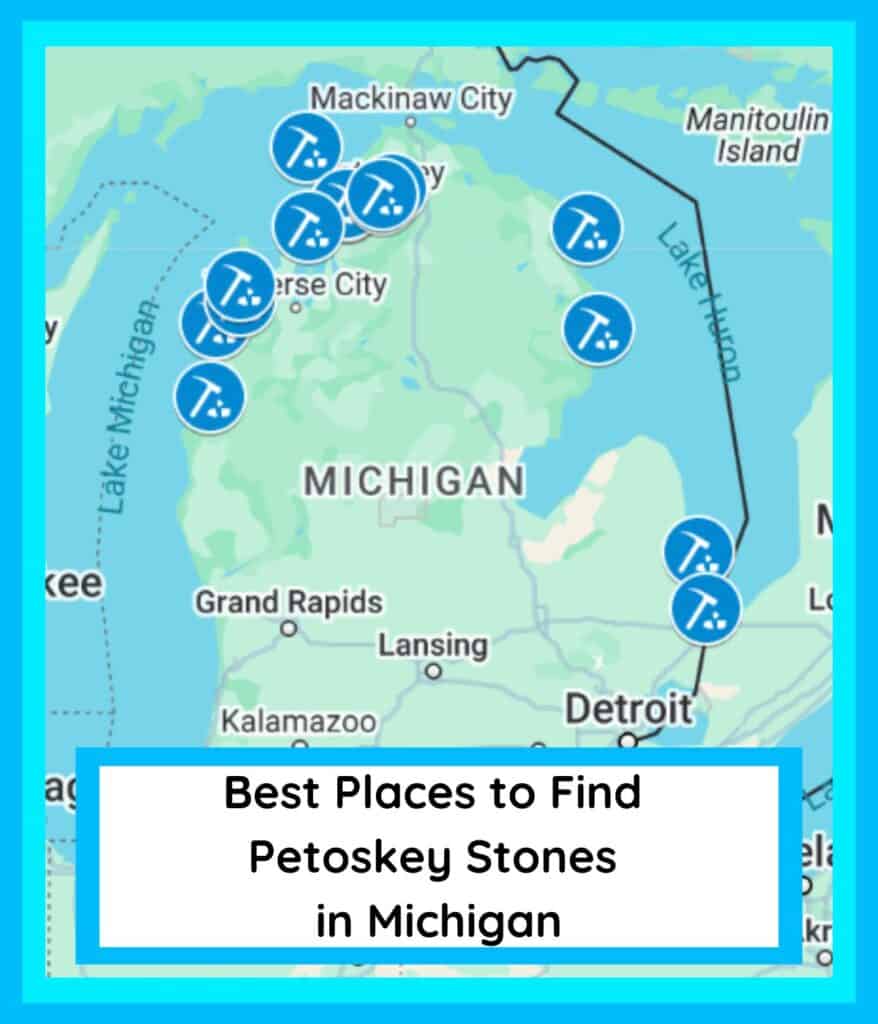
Here are 15 beaches where they actually turn up, the conditions that separate a full bag from an empty one, and the collecting rules that carry real fines.
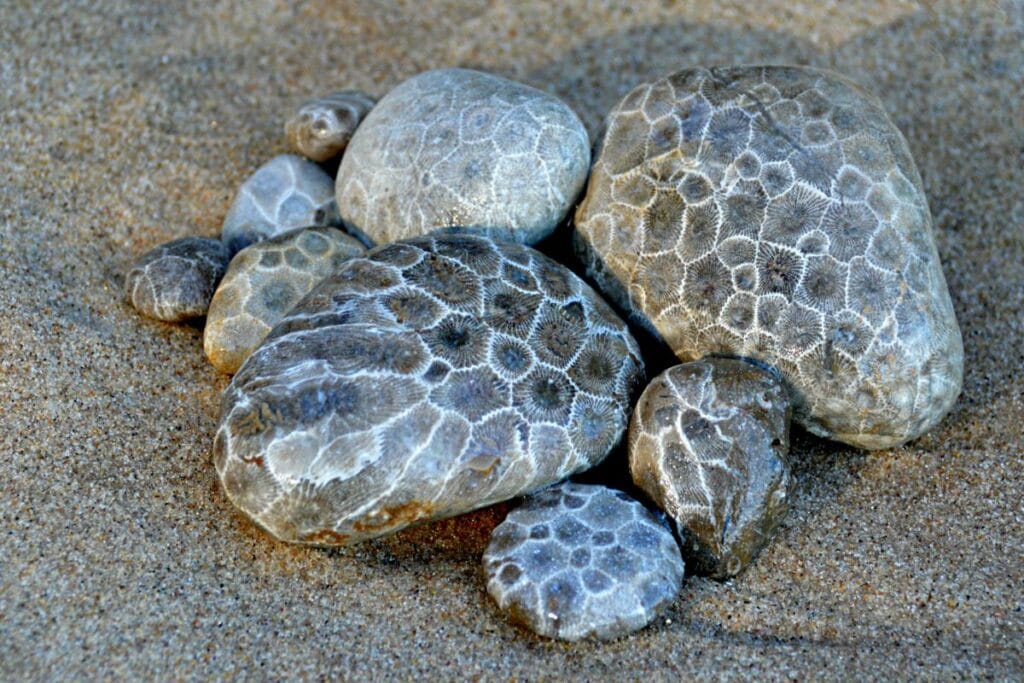
I found my first one at seven years old on a rocky stretch north of Charlevoix — gray, wet, unremarkable, until the light hit it and the hexagons appeared. I have been hooked ever since. Of everything I have covered across this state for WDIV Detroit, this is the one Michigan habit I would hand to a stranger.
🪨 At a Glance: Petoskey Stone Hunting
- 🏆 Best overall: Petoskey State Park on Little Traverse Bay — the most reliable spot in the state
- 🤫 Least crowded: Fisherman’s Island State Park — six miles of rocky shore south of Charlevoix
- 🦴 Best for fossils generally: Rockport near Alpena — a former limestone quarry, not a beach
- ⏰ Best time: April–early June, or the morning after any big storm
- 💧 The one trick: Wet the stone. Dry, it’s a gray rock. Wet, the pattern is unmistakable
- ⚖️ Legal limit: 25 lbs per person, per year on state land — fines up to $500
- 🚫 Look but don’t take: Sleeping Bear Dunes and all National Park Service land
What Are Petoskey Stones?
A Petoskey stone is the fossilized skeleton of a colonial rugose coral — Hexagonaria percarinata — that lived roughly 350 million years ago, in the Devonian, when Michigan sat near the equator under a warm shallow sea. Each stone is packed with six-sided cells called corallites, and the dark dot at the center of every hexagon was a single coral polyp’s mouth.
About two million years ago, glaciers plucked those fossils out of the bedrock, ground off the edges, and scattered them across northern Michigan. That’s why you find them loose on beaches instead of locked in stone — and why they concentrate around Little Traverse Bay, near the town they’re named for.
Governor George Romney signed them into law as Michigan’s official state stone on June 28, 1965. Ella Jane Petoskey, the only living grandchild of Chief Petoskey, attended the signing.

Petoskey Stone vs. Charlevoix Stone
Most guides get this wrong, so it’s worth being precise: a Charlevoix stone is not a small Petoskey stone. It’s a different coral entirely.
Petoskey stones are Hexagonaria, from the coral group Rugosa. Charlevoix stones are Favosites — honeycomb coral — from the group Tabulata. Different genus, different family, and Favosites was around for roughly four times as long as Hexagonaria. They are cousins, not siblings.
In your hand, the tell is the pattern: Charlevoix stones have much smaller, tighter cells packed close together, and the overall shape tends to be more irregular. Petoskey stones have larger, more distinct hexagons with a clearly visible dark center in each one.
Charlevoix stones are the rarer find, so if you come home with one, that’s the bigger score. They turn up on the same beaches, so you’ll likely have both in the bag without realizing it until you lay them out side by side.

How to Find Petoskey Stones: 6 Tips That Work
The gap between an empty bag and a dozen stones in an hour is almost never luck. It’s conditions.
- Wet the stone. This is the whole game. Dry Petoskey stones are invisible — they look like every other gray rock. Carry a spray bottle, or work the waterline where the waves keep everything wet. A quick spritz confirms or eliminates a candidate in two seconds
- Hunt after a storm, not on a perfect beach day. Waves churn stones up from the lake bottom and lay down a fresh layer. My best hunt ever came on a gray October morning after two days of northwest wind, on a beach that had been picked clean all summer
- Go rocky, not sandy. Sandy beaches are for swimming. Petoskey stones hide in mixed gravel — the kind that’s miserable on bare feet. That discomfort is the signal you’re in the right place
- Walk away from the parking lot. The first 50 yards from any beach access are picked over. Every additional minute you walk improves your odds
- Look above the waterline too. Around uprooted trees, in disrupted soil, along the base of bluffs. Almost everyone works the waterline and nowhere else — the stones behind them go untouched
- When you find one, stop walking. Petoskey stones cluster, because the glaciers that dropped them dropped them in patches. Find one and work that patch hard before you move on
Best season: early spring, as soon as the ice breaks. Winter storms deliver a fresh crop and you’ll be among the first to see it. April through early June is the window, before the summer crowds work the beaches over.
💡 PRO TIP: Bring a small bucket, not just a spray bottle. Scoop lake water and pour it over a whole patch of gravel at once — you’ll clear a section in seconds instead of testing stones one at a time. And yes, some hunters lick the stones. It works. I’d stick with the bucket.

Michigan’s Rock Collecting Rules
The Michigan DNR permits up to 25 pounds of rocks, minerals, and fossils per person, per year from state-owned and public-trust land. That’s a total annual figure — not per beach, not per trip. Violations carry civil fines of up to $500, and the DNR enforces it: they once confiscated a 93-pound Petoskey stone a collector hauled out of Lake Michigan.
| Land type | Can you collect? |
|---|---|
| State parks & state land | ✅ Yes — 25 lbs per person per year |
| Great Lakes shoreline to the high-water mark | ✅ Yes — same annual limit |
| City & county parks | ✅ Generally yes — obey posted rules |
| National Lakeshore (Sleeping Bear, Pictured Rocks) | 🚫 No — illegal. Look, photograph, leave it |
| Private property | ✅ With the owner’s permission |
The one that catches people out is Sleeping Bear Dunes National Lakeshore. It sits right in the middle of prime Leelanau hunting country, the boundary isn’t obvious from the sand, and removing any natural material from National Park Service land is illegal. In 2025, visitors were fined and banned from Pictured Rocks for hauling out rocks. Rangers do enforce this.
Individual state parks can also set stricter limits, so read the posted signage. More detail in our guide to rock hunting in Michigan.

Where to Find Petoskey Stones on Lake Michigan
The northern Lake Michigan shore between Traverse City and Petoskey is the heart of it. These are the spots that consistently produce.
1. Petoskey State Park — Emmet County
Petoskey State Park on Little Traverse Bay is the single most reliable Petoskey stone spot in Michigan, about two miles northeast of town off M-119. The real concentrations are in the water, not on the sand — bring water shoes and a mask and wade in. Recreation Passport required.
Note: dogs are not permitted on the lakeshore here — it’s piping plover habitat.
2. Magnus City Park — Petoskey
Easier access than the state park, right off downtown Petoskey, with about 1,000 feet of shoreline. Good for a quick hunt when you don’t have a half-day.
3. Bay Front Park and Sunset Park — Petoskey
Both are walkable from downtown Petoskey and both produce, though they see heavy traffic. Best right after a storm, before anyone else gets there.
4. Fisherman’s Island State Park — Charlevoix
My pick for the best combination of productivity and solitude. Fisherman’s Island sits south of Charlevoix off Bells Bay Road with six miles of rocky Lake Michigan shoreline — heavily rocky, consistently productive, and rarely crowded. It’s also one of the better spots for Charlevoix stones specifically. Recreation Passport required.
💡 PRO TIP: At Fisherman’s Island, most people never get past the first stretch of shore near the entrance. Keep walking. The park runs six miles, and the further south you go, the fresher the gravel.
5. Mt. McSauba Beach — Charlevoix
A city recreation area on the Lake Michigan shore just north of Charlevoix, and a solid producer of both Petoskey and Charlevoix stones.
6. Michigan Beach Park — Charlevoix
Right in town by the pier and lighthouse. Convenient, popular, and worth a walk if you’re already in Charlevoix — just expect company.
7. Beaver Island
A ferry ride out from Charlevoix, and the isolation is the point. Far less foot traffic than anywhere on the mainland, and the beaches show it.
8. Peterson Park — Northport (Leelanau County)
Near the tip of the Leelanau Peninsula, with a high-bluff view and a rocky quarter-mile of shoreline below. The stairs down are steep — wear real shoes. Petoskey stones, jasper, and slag all turn up here.
9. Christmas Cove Beach — Northport
Also near Northport, and notable for Favosites — honeycomb coral, the Charlevoix stone’s parent — alongside Leland Blues and Frankfort Greens.
10. Van’s Beach and North Beach — Leland
Leland is best known for Leland Blues — blue-green slag glass left over from the town’s 19th-century iron smelting — but Petoskey stones turn up here too. Van’s Beach is the classic stop.
11. Leelanau State Park — Northport
Leelanau State Park at the very tip of the peninsula has a rocky, less-trafficked shore that rewards patience. Recreation Passport required.
12. Point Betsie — Benzie County
The area around Point Betsie Lighthouse is worth the trip — but don’t hunt the sandy beach directly in front of the lighthouse. Follow the trails behind it a quarter-mile and work the small rocky offshoots. That’s where the finds are. Petoskey and Charlevoix stones, chain coral, quartz, and slag all show up.
13. Orchard Beach State Park — Manistee
Orchard Beach sits on a bluff above Lake Michigan. The staircase down is a workout, which is precisely why the shoreline is less picked over than spots further north. Recreation Passport required.

Where to Find Petoskey Stones on Lake Huron
Lake Huron is the underused half of Petoskey country. Nearly everyone defaults to Lake Michigan, which is exactly why the Huron shore is worth the drive — same stones, a fraction of the competition.
14. Rockport State Recreation Area — Alpena
Set your expectations correctly here, because Rockport is not a beach hunt. It’s a 300-acre abandoned limestone quarry — operations ceased in 1958 — where the discarded rock was left in piles that you are free to sort through. You’re walking a Devonian sea floor, and the fossils are everywhere: Petoskey stones, Favosites, brachiopods, the occasional trilobite fragment.
Bring sturdy boots — the rock is loose and ankles turn — plus a bucket and sun protection, because the quarry offers zero shade. It’s a day-use park with basic facilities and no camping. Recreation Passport required. It’s also a designated Dark Sky Preserve, which makes it a spectacular place to stay until the stars come out.
15. Harrisville State Park — Alcona County
A consistent producer on the northern Lake Huron shore, with a campground attached if you want to make a weekend of it. Recreation Passport required.
Also Worth Knowing on Lake Huron
- Huron Shores Roadside Park — pudding stones by the handful, plus Petoskey stones and limestone
- P.H. Hoeft State Park — miles of beachfront, 120+ campsites, good fossil hunting
- Lake Huron Roadside Park, Port Sanilac — easy access and surprisingly good hunting on the Thumb
- Fort Gratiot County Park, Port Huron — the southernmost spot worth checking

The Story Behind the Name
The stone is named for the city, and the city is named for Chief Ignatius Petoskey — born Neyas Petosega around 1787 — an Odawa leader of the Bear River band, son of an Odawa mother and a French fur trader. His name derives from the Odawa biidaasige: “first light of day,” or the rays of the rising sun.
The story handed down is that sunbeams broke across his face at the moment of his birth, marking a life of significance. Whether or not that’s literal, the fit is hard to ignore — every polished Petoskey stone shows the same rays radiating out from the center of each cell. A bronze statue of him stands on a bluff over Little Traverse Bay.
How to Polish a Petoskey Stone
A freshly found Petoskey stone is usually a letdown once it dries out. Polishing is what turns it into something you’ll actually put on a shelf.
Start with 220-grit wet sandpaper and work up through progressively finer grits — 400, 600, 1000, then 2000 — keeping the stone wet the entire time. Finish with a car polish like Turtle Wax for the glassy shine.
💡 PRO TIP: Skip the rock tumbler. Petoskey stones are relatively soft — a tumbler will round off the fossil detail you’re trying to reveal, and can crack the stone outright. Hand-sanding takes longer and gives a far better result.
More Michigan Beach Finds
If Petoskey hunting has hooked you, three more are worth knowing. Yooperlites are UP rocks rich in fluorescent sodalite that glow orange under a 365nm UV light after dark. Lake Superior agates are the banded prize of the UP gravel beaches. And Leland Blues — blue-green slag from Leland’s 19th-century iron smelting — turn up all along the Leelanau shore.
Petoskey Stone FAQ
Where is the best place to find Petoskey stones?
Petoskey State Park on Little Traverse Bay is the most reliable spot in Michigan, with the heaviest concentrations in the shallow water rather than on the sand. Fisherman’s Island State Park south of Charlevoix is the best combination of productivity and solitude, with six miles of rocky shoreline. On Lake Huron, Rockport near Alpena is a former limestone quarry loaded with Devonian fossils.
How do you identify a Petoskey stone?
Wet it. Dry, a Petoskey stone looks like ordinary gray limestone; wet, the six-sided honeycomb pattern appears immediately, with a dark dot at the center of each cell. That dot was a coral polyp’s mouth. Carry a spray bottle or a bucket and test anything that looks even vaguely promising.
What is the best time of year to find Petoskey stones?
April through early June. Winter storms and spring ice break-up push a fresh crop of stones onto the shoreline, and the summer crowds haven’t worked the beaches over yet. Beyond that, the morning after any significant storm is excellent, in any season.
What is the difference between a Petoskey stone and a Charlevoix stone?
They are different corals. Petoskey stones are Hexagonaria, from the rugose coral group, with larger hexagonal cells each showing a dark center. Charlevoix stones are Favosites — honeycomb coral, from the tabulate group — with much smaller, tighter cells and a more irregular shape. Charlevoix stones are the rarer find.
Can you find Petoskey stones at Sleeping Bear Dunes?
You can find them there, but you cannot take them. The National Park Service prohibits removing any natural material from Sleeping Bear Dunes National Lakeshore, and rangers enforce it. Look, photograph, and put it back. Nearby Leelanau State Park, Peterson Park, and Van’s Beach all allow collecting within the DNR limit.
How many Petoskey stones can you legally take?
The Michigan DNR permits up to 25 pounds of stones, minerals, or fossils per person per year from state-owned and public-trust land. That is a total annual limit, not per beach or per visit, and violations carry fines of up to $500. Individual state parks may set stricter rules, and no collecting at all is permitted on National Park Service land.
How old are Petoskey stones?
About 350 million years. They are fossilized colonial coral from the Devonian period, when Michigan sat near the equator beneath a warm shallow sea. Glaciers scraped them from the bedrock roughly two million years ago and scattered them across northern Michigan’s beaches.
Go Get Wet
The thing I love about Petoskey hunting is that it costs nothing and rewards patience over gear. A bucket, a rocky beach, and a gray morning after a storm is the entire setup. Everything else is just walking slowly and paying attention.
Respect the 25-pound rule, stay out of the national lakeshores, and leave plenty behind for whoever walks the beach tomorrow.
- About Jill
- Recent Michigan Travel Tips

Jill Halpin is a Michigan travel expert and founder of MyMichiganBeach.com. She has been sourced by The Washington Post and featured in The Detroit News and Detroit Free Press, and appears regularly on WDIV Detroit, FOX 2 Detroit, FOX 17 West Michigan, FOX 32 Chicago, WGN Chicago, and NewsNation — 60+ television appearances to date. She holds an MLIS from Wayne State University and is a Library of Congress Information Science Fellow. See all media features.
I have hunted for Yooperlites for a number of years and the very BEST one I have ever found was at Petoskey State Park last week looking for Petoskeys at night with my UV 365 light. I also found some nice Petoskeys.