
Michigan Rockhunting: 15+ Top Spots for Rockhounding and Rock Hunting in Michigan (MAP)
Last Updated: October 2026
If you’re a Michigan rockhounder, you’re going to want this list of the top spots for rock hunting in Michigan. With more than 3,000 miles of Great Lakes coastline, the state has endless beaches for rockhounding — and an incredible variety of stones, from the famous Petoskey to Leland Blues, Lake Superior agates, and glowing Yooperlite.
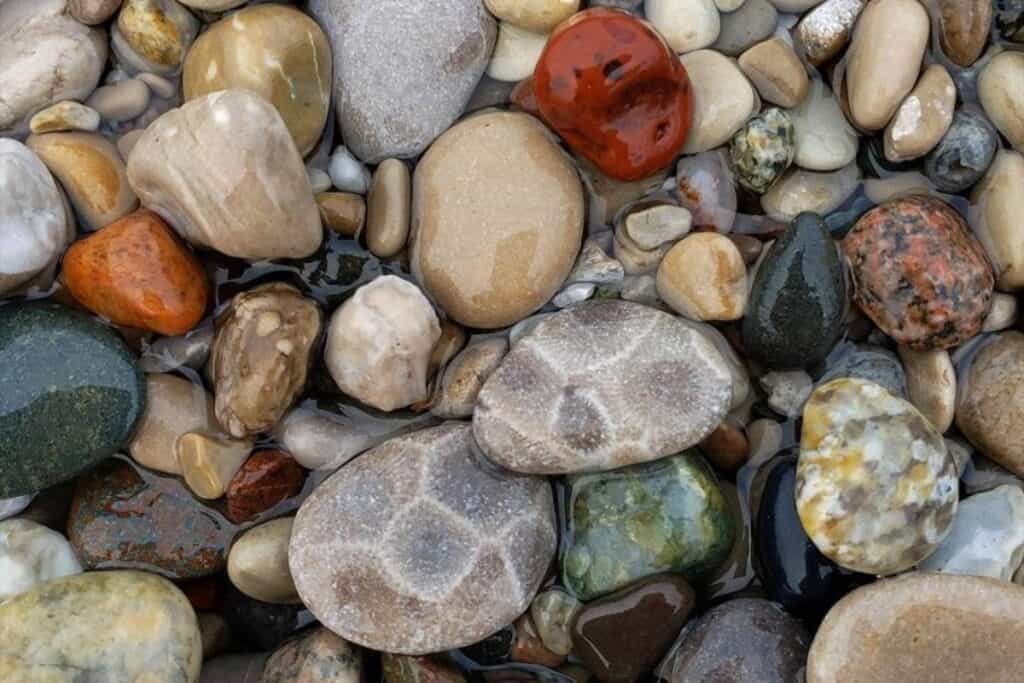
While we all know Michigan beaches are great for relaxing in the sand, they’re also fantastic spots for fossil hunting, collecting rocks and minerals, and finding brightly colored beach glass. I’ve spent endless hours combing the beaches, and I’m sharing some of my favorite spots, so grab your pail and let’s get going.
The best rock-hunting beaches in Michigan let you discover Petoskey stones (Hexagonaria percarinata), Lake Superior agates, chlorastrolite (the state gem, also called greenstone), chalcedony, and more. Michigan is one of the best states for rock hunting thanks to the surrounding Great Lakes and a geological history rich in economically valuable minerals.
Below are my favorite spots for finding Petoskey stones, Leland Blues, Yooperlite, chert, jasper, and many other rocks and minerals in Michigan, organized by region.
🪨 At a Glance: Rock Hunting in Michigan
- 💎 What you’ll find: Petoskey & Charlevoix stones, Leland Blues (slag), agates, Yooperlite, pudding stones, jasper, chert, unakite
- 🌟 Best for agates & Yooperlite: Lake Superior beaches in the UP (Grand Marais, Calumet, Whitefish Point)
- 🌊 Best for Petoskey stones: northern Lake Michigan & Lake Huron (Petoskey State Park, Point Betsie)
- ⏰ Best time: after a strong storm, and in spring when ice push exposes fresh rocks
- ⚖️ Legal limit: 25 lbs per person per year on state land — and no collecting at all in national parks like Pictured Rocks or Sleeping Bear
- 🎫 State park entry: Michigan Recreation Passport, $15 a year on a Michigan plate or $12 a day for out-of-state vehicles (2026)
Interactive Map of 15+ Top Spots for Michigan Rock Hunting

Best Beaches for Rock Collecting in Northwest Michigan
Van’s Beach, Leland
The first stop on our tour is Van’s Beach in Leland. Located just north of Sleeping Bear Dunes National Lakeshore on the scenic Leelanau Peninsula, Leland is a popular Michigan travel destination — and one of the state’s most famous rockhounding beaches.
Van’s Beach is the place for Leland Blue stones, a byproduct of smelting left over from the Leland Lake Superior Iron Company that operated here in the late 1800s. This slag — in shades of blue, purple, gray, and green — still turns up along the beach. It takes patience to spot, but once your eye adjusts, an early summer morning here can be a treasure hunt.
Pro tip: Not a morning person? Leland Blue is easier to find in spring and fall, and especially right after a strong storm churns up the shoreline.

Point Betsie Lighthouse Beach, Frankfort
Right below the much-loved Point Betsie Lighthouse near Frankfort is our next destination. Point Betsie Beach turns up interesting rocks including Petoskey and Charlevoix stones, chain coral, quartz, and slag. On the shore of Lake Michigan, it’s one of the top Lake Michigan beaches for finding fossilized coral — the Petoskey and Charlevoix stones.
The fossil coral in these stones is hundreds of millions of years old, dating to the Devonian period — so when you pick one up, you’re holding a piece of an ancient sea that once covered Michigan.
Peterson Park, Northport
At the tip of the Leelanau Peninsula, Peterson Park is one of the standouts of Michigan rockhounding. With a beautiful high-bluff view of Lake Michigan, rock lovers can spot stones all along its rocky quarter-mile of shoreline. Finds here include Petoskey stones, jasper, slag, and many other pretty stones. The stairs down to the beach are steep, so wear good shoes.
Christmas Cove, Northport
Also near Northport, Christmas Cove Beach holds various rock types, most notably favosite (honeycomb coral), Leland Blues, and Frankfort Greens. It’s Peterson Park’s sandier, more peaceful cousin. Some rockhounds report finding Petoskey stones and even rare pieces of unakite here. The parking area has been affected by erosion, which can make beach access harder — check local conditions before you go.
Petoskey State Park, Petoskey
Petoskey State Park is one of the best-known rockhounding spots in the state, famous for Michigan’s state stone — the Petoskey stone — and its lesser-known cousin, the Charlevoix stone. Walk the Lake Michigan shoreline along Little Traverse Bay, a reliable hot spot for both. A Recreation Passport is required for park entry.
Pro tip: Find a stretch that’s uncrowded and a little rocky, and go right after a big storm — wave action churns up fresh stone deposits.

Best Beaches for Rockhounding in Northeast Michigan
Huron Shores Roadside Park, Cheboygan County
Home to an abundance of pudding stones — from pebble- to palm-size — Huron Shores Roadside Park is a great Lake Huron stop. Beyond the pudding stones you’ll find Petoskey stones and plenty of limestone, all with a beautiful Lake Huron view.
P.H. Hoeft State Park, Rogers City
Named for lumberman and businessman Paul H. Hoeft, this Lake Huron park offers a few miles of beachfront full of pretty stones. You can swim, walk the maintained trails, and hunt for fossils and pudding stones, and with more than 120 campsites it’s easy to make a multi-day rockhounding trip of it. (A Recreation Passport is required for entry.)
Rockport State Recreation Area, Alpena
Michigan’s 100th state park opened in 2012 and instantly became one of the most distinctive rockhounding spots in the state. A former limestone quarry, Rockport in Alpena is a fossil lover’s paradise, with coral and other marine fossils, large pudding stones, and limestone around its water-filled sinkholes. The crystal-clear water of Lake Huron and the rugged landscape make it rewarding for novices and experienced hunters alike.

Best Beaches for Rockhounding in Southwest Michigan
Deerlick Creek Park, South Haven
This is one of the few spots where you can find an abundance of Lake Michigan septarian nodules, better known as lightning stones. Along the rocky shoreline of Deerlick Creek in South Haven, Lake Michigan deposits stray coral fossils, blue slag glass, and Petoskey stones. At only about 50 yards, it’s a small beach that suits a beginner rockhound.
Pier Cove Park, Allegan County
While Pier Cove Park near Saugatuck isn’t home to many rare rocks, it’s full of pretty ones: black basalt, striped sandstone, freckled granite, and bright limestone are easy finds. Keep looking and you might turn up a septarian “brown stone,” identified by its cracked-egg appearance. It’s a small beach with only about ten parking spots, but a lovely place for a stone-hunting walk.

Best Beaches for Rock Hunting in Southeast Michigan
Lakeport State Park, Lakeport
Lakeport State Park sits along Lake Huron on Michigan’s “Blue Thumb Coast.” Rockhounds here can find chert, quartz, granite, and fossils. The Thumb is also sandstone country — the same stone carved at the Sanilac Petroglyphs inland — so keep an eye out for loose pieces along the shore. (A Recreation Passport is required for entry.)
Best Rock Hunting Beaches in Michigan’s Upper Peninsula
Agate Beach (Grand Marais Public Beach), Grand Marais
The rocks are in the name: the Lake Superior agate is one of the most sought-after prizes for any Michigan rockhound. Agate Beach is one of the best places in the state to hunt for them, alongside common-but-pretty unakite and quartz, with big views toward Pictured Rocks National Lakeshore. For nine more Lake Superior agate beaches and how to tell an agate from a lookalike, see my guide to finding agates in Michigan.
⚠️ Pictured Rocks boundary
- Collecting rocks is prohibited inside Pictured Rocks National Lakeshore and all national parks — pay attention to the boundary signage and stay on the public Grand Marais beach.
- In July 2025, rangers caught four visitors who had carved the cliffs and gathered more than 100 pounds of rock. Each paid a $500 fine and drew a one-year ban, and one paid another $250 for the rock collecting alone.
- Bring sturdy shoes; Lake Superior is cold even in summer.
Calumet Waterworks Park, Calumet Township
Calumet Waterworks Park is many rockhounds’ favorite beach in the state. It sits south of Copper Harbor on the Keweenaw Peninsula, a stunning destination especially in autumn when the fall colors come alive. Agates turn up here, along with dozens of pretty stones — and if you’re lucky, a Yooperlite, a syenite rock that glows bright orange and yellow under UV light. Bring a UV flashlight after dark for an otherworldly hunt.
Whitefish Point Beach, Whitefish Point
Agates, jasperlite, and unakite are all here for rock lovers along the shores of Lake Superior at Whitefish Point. Along with the scenery, this beach has a rarity on this list: it’s reachable entirely by paved road. The eastern UP is one of the best regions in the state for rockhounding, so Whitefish Point makes an easy, rewarding stop.
Muskallonge Lake State Park, Newberry
Another eastern UP standout, Muskallonge Lake State Park sits between Lake Superior and inland Muskallonge Lake. Small agates and larger chunks of unakite are abundant on the Superior beach if you look hard enough. It’s also a campground, so you can hunt, sleep, and hunt again as Lake Superior keeps depositing fresh stones. (A Recreation Passport is required for entry.)

Mouth of the Two Hearted River, Luce County
Rounding out the list is the remote beach where the Two Hearted River meets Lake Superior. The river was a favorite of writer Ernest Hemingway, who memorialized it in his Nick Adams story “Big Two-Hearted River.” The river runs nearly parallel to the lake, creating a spit full of quartz, chert, unakite, and even rare agate. Getting here takes some dedication, but the view of one of the prettiest streams in the state is worth it — even if you go home empty-handed.
Michigan Rockhounding Laws and Regulations
Before you fill your pail, know the rules — they protect these beaches and keep the hobby legal. Michigan’s are more generous than the federal limit, but there are important boundaries.
- 25-pound annual limit: You may collect up to 25 pounds of rocks, minerals, and fossils per person, per year from state-owned land and public-trust land (Great Lakes shorelines up to the ordinary high-water mark, plus bottomlands). The rule is on the state’s rockhounding page.
- National parks are off-limits: Collecting is prohibited inside Pictured Rocks and Sleeping Bear Dunes National Lakeshores, Isle Royale, and all national parks. The 2025 Pictured Rocks case above ended in $500 fines and one-year bans — the rangers do enforce this.
- National forests differ: On national forest land (Hiawatha, Ottawa, Huron-Manistee) the Forest Service permits rock and gravel removal separately from the state rule, so call the local ranger district before taking more than a pocketful. Hiawatha’s supervisor’s office is (906) 428-5800.
- Beach glass doesn’t count: Sea glass, beach glass, and slag glass (like Leland Blue) are treated as litter rather than minerals, so the 25-pound limit doesn’t apply to them.
- Never take artifacts: Removing artifacts, native cultural items, or shipwreck material from state and public-trust land is always illegal.
- Respect private property: The public shoreline is narrow — land above the high-water mark is often private. Stay on public land and watch for hazards and uneven footing.
For the official details, check the Michigan Department of Natural Resources.
The Michigan Traveler
Rock hunting is a weather sport: the best beaches are the ones a storm just rearranged. I keep about 14,000 Michigan travelers posted on which shoreline got hit, which parks changed their rules, and where I’m heading next, before it ends up in a guide. If you want first crack at fresh gravel, come along.
Frequently Asked Questions About Michigan Rock Hunting
What rocks can you find on Michigan beaches?
Michigan beaches are known for Petoskey stones (the state stone, a fossil coral) and their cousin the Charlevoix stone, plus Lake Superior agates, Yooperlite, Leland Blue slag, pudding stones, jasper, chert, unakite, quartz, and chlorastrolite (greenstone, the state gem). Different lakes favor different finds — Lake Superior for agates and Yooperlite, northern Lake Michigan and Lake Huron for Petoskey stones.
Where is the best place to find Petoskey stones in Michigan?
Northern Lake Michigan and Lake Huron beaches are best, especially Petoskey State Park near Petoskey and Point Betsie near Frankfort. Petoskey stones are fossilized coral, so look for the distinctive hexagonal honeycomb pattern, which shows up most clearly when the stone is wet.
Where can you find Lake Superior agates and Yooperlite?
Lake Superior beaches in the Upper Peninsula are the spot. Agate Beach in Grand Marais, Calumet Waterworks Park on the Keweenaw, Whitefish Point, and Muskallonge Lake State Park are all excellent. Yooperlite — a rock that glows orange under UV light — is best found after dark with a UV flashlight along Lake Superior.
Is it legal to collect rocks on Michigan beaches?
Yes, within limits. You can collect up to 25 pounds per person per year from state-owned and public-trust land, including most Great Lakes shorelines. Collecting is prohibited inside national parks like Pictured Rocks and Sleeping Bear Dunes, and you can never take artifacts or shipwreck material. National forest land follows Forest Service rules instead, so check with the ranger district.
What is the best time of year for rock hunting in Michigan?
Right after a strong storm is ideal — wave action churns up fresh stones. Spring is also excellent, because winter ice push exposes rocks along the shoreline before the summer crowds pick them over. Early mornings give you first crack at a freshly washed beach.
How many rocks can you legally take in Michigan?
Up to 25 pounds of rocks, minerals, and fossils per person per year from state-owned and public-trust land. Beach glass and slag glass don’t count toward the limit. The cap is enforced — the DNR has confiscated oversized hauls, including a 93-pound Petoskey stone a collector pulled from Lake Michigan near Northport.
Start with whichever shoreline is closest to you, then work toward Superior; the agates are worth the drive, and the Yooperlite hunt after dark is the thing people come back for. If Petoskey stones are the goal, my Petoskey stone guide covers how to spot and polish them. Happy rock hunting.
- About Jill
- Recent Michigan Travel Tips

Jill Halpin is a Michigan travel expert and founder of MyMichiganBeach.com. She has been sourced by The Washington Post and featured in The Detroit News and Detroit Free Press, and appears regularly on WDIV Detroit, FOX 2 Detroit, FOX 17 West Michigan, FOX 32 Chicago, WGN Chicago, and NewsNation — 60+ television appearances to date. She holds an MLIS from Wayne State University and is a Library of Congress Information Science Fellow. See all media features.
thank you for sharing this with us. I have always wanted to go rock hunting in Michigan, since I visited Mackinac Island and heard about these beautiful stones. thanks again