
Michigan Peak Fall Colors 2026: Forecast + Peak Dates by Region
Color estimates below recalculate automatically. Guide last reviewed October 2026.
Michigan Fall Color Report
Where the color is right now, region by region, with current conditions for each.
Loading the color model…
Regional progress is estimated, not measured: each region’s usual timing, adjusted by how cold its nights have run over the past two weeks compared with a ten-year average for that exact location and date. Official statewide sources: Michigan DNR and Pure Michigan.
Color estimates are modeled from Open-Meteo overnight-low history, not an observation. Weather and climate data by Open-Meteo. Peak timing varies year to year and by elevation.
Michigan peak fall colors move north to south across roughly four weeks, and the single most useful thing I can tell you is this: lakeshore towns peak about a week after the inland forests beside them. Almost every guide skips that, and it is the difference between arriving at Sleeping Bear in full color and arriving to bare branches inland with the shoreline still stubbornly green.
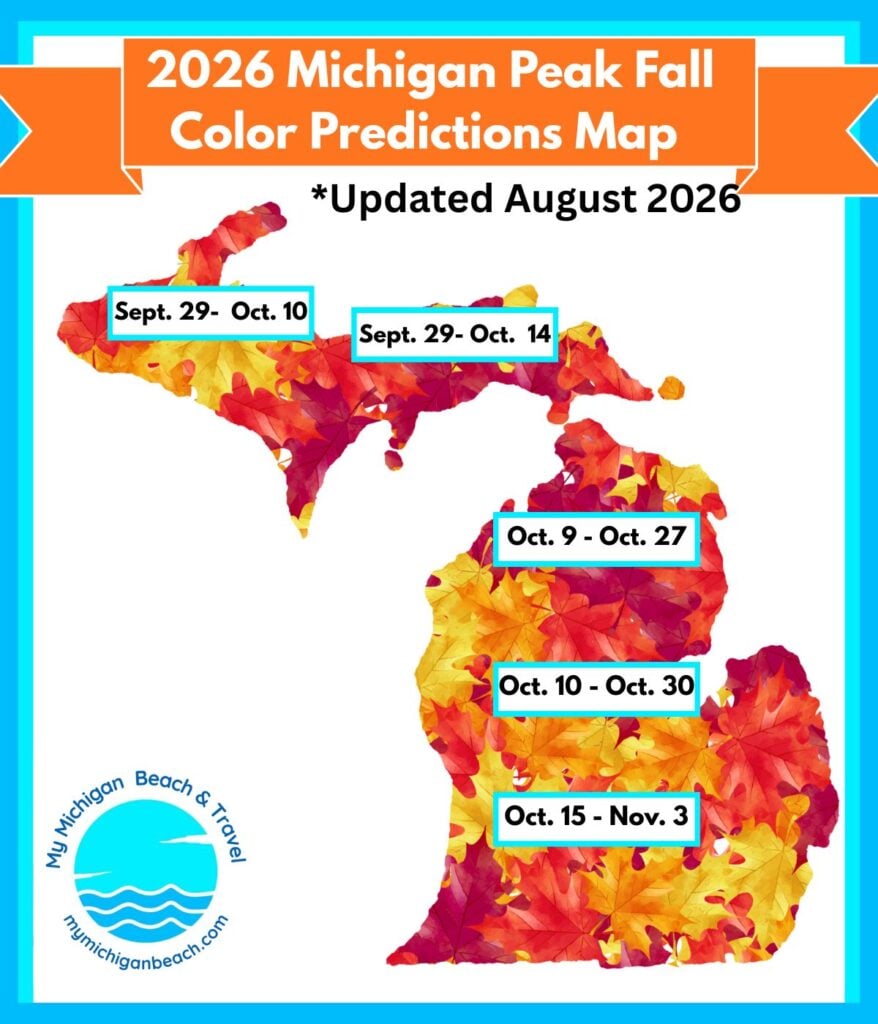
I have been chasing Michigan’s fall color for over two decades, from the Lake Superior shore in the Upper Peninsula to the bluffs of West Michigan, and I have never seen two seasons run the same. Covering fall travel for WDIV Detroit, the question is always the same — when do I go? Here is the 2026 outlook, the regional windows, and the timing rules that actually matter.
🍂 At a Glance: Michigan Peak Fall Colors 2026
- 🔮 The 2026 call: A near-average season, with no widespread drought stress heading into fall
- 🗓️ The season: Roughly four weeks, late September through early November, moving north to south
- 🥇 First to turn: Western Upper Peninsula — the Porcupine Mountains and Keweenaw, last days of September into the first week of October
- 🍁 The sweet spot for most people: Northern Lower Michigan, second and third weeks of October
- 🏁 Last to turn: Southeast and Southwest Michigan, late October into early November
- 🌊 The rule nobody tells you: Great Lakes shoreline towns peak five to ten days after nearby inland forests
- ⚠️ 2026 road alert: Two sections of M-119, the Tunnel of Trees, are closed to through traffic after April flooding — detours are in place
- 📆 Go mid-week. The color is identical on a Tuesday. The traffic is not.
The 2026 Michigan Fall Color Outlook
The 2026 outlook points to a near-average season for Michigan, which is better news than it sounds. Average is what produces the display people drive six hours for — it is the extremes, drought or a warm wet autumn, that dull the palette.
Two things support that read. The Old Farmer’s Almanac 2026 foliage forecast expects most regions to hit near-average peak color, with Michigan following its usual pattern: the Upper Peninsula changing in late September, the northern Lower Peninsula in early October, and southern Michigan by late October.
More telling is the moisture picture. As of late July 2026, roughly 2% of Michigan was in active drought and 12% classified as abnormally dry, according to the U.S. Drought Monitor. Drought stress is what makes trees drop leaves early and brown rather than turn, and Michigan is going into this fall without much of it. That is the setup you want.
💡 PRO TIP: Treat any long-range forecast as a planning baseline, not a promise. What actually decides your trip is the three weeks before you go — cool nights and sunny days sharpen the color, and one windstorm can end it. That is exactly what the report at the top of this page is built to catch: it compares the overnight lows that have actually happened in each region against a ten-year average for that spot, and shifts the peak window accordingly.
When Michigan Fall Colors Peak, by Region
Michigan’s color progression follows a reliable pattern rooted in latitude and lake effect. When nights drop below 50°F and days shorten past the equinox, chlorophyll breaks down and the oranges, reds, and golds that were always in the leaf finally show. That process starts in the coldest northern forests and rolls south at roughly 15 to 20 miles a day.
| Region | Typical Peak Window |
| Western Upper Peninsula (Porkies, Keweenaw) | Late Sept – first week of Oct |
| Eastern Upper Peninsula (Tahquamenon) | First two weeks of Oct |
| Northern Lower Michigan (Tunnel of Trees, Sleeping Bear, Traverse City) | Second and third weeks of Oct |
| Lake Huron & the Sunrise Coast | Second and third weeks of Oct |
| Mid-Michigan & the Thumb | Mid to late Oct |
| Southeast & Southwest Michigan | Late Oct – early Nov |
| Lake Michigan shoreline towns | Add 5–10 days to the inland window |
💡 PRO TIP: If you are combining an inland forest drive with a beach town — say, the Tunnel of Trees and then Charlevoix — go inland first, then move toward the water. The lake holds summer heat and delays the shoreline change. Do it in the wrong order and you will hit bare trees inland and green ones on the coast.
⚡ Quick Picks by Interest
- 🥇 Best single view: Lake of the Clouds, Porcupine Mountains, first week of October
- 🚗 Best drives: Pierce Stocking Scenic Drive, Brockway Mountain, M-22 through Leelanau
- ♿ Best accessible: Ocqueoc Falls, Lake of the Clouds overlook boardwalk, Tahquamenon Lower Falls
- 🐕 Best dog-friendly: Kensington Metropark, Ocqueoc Falls, Presque Isle Park in Marquette
- 💧 Best color and water together: Tahquamenon Falls, the Au Sable River near Oscoda, Suttons Bay
- 🏙️ Best close to Detroit: Kensington Metropark, Waterloo Recreation Area, Dexter cider mills
- 🌅 Best late-season backup: Southeast Michigan oaks, holding russet into November
Accessible and Dog-Friendly Fall Color Stops
Ocqueoc Falls near Rogers City is the strongest accessible recommendation in Michigan, and it is not close. In 2012 the DNR redesigned the site and it became the nation’s first truly universally accessible waterfall — not a paved path to a viewing deck, but tiered limestone slabs and transfer platforms that let wheelchair users get into the water. Leashed dogs are welcome on a six-foot lead.
The Lake of the Clouds overlook in the Porcupine Mountains has an accessible boardwalk to the viewing platform, which means the best vista in the state is available to everyone in your group. At Tahquamenon Falls, the Lower Falls has paved, stroller-friendly pathways; the Upper Falls involves stairs.
For dogs, Kensington Metropark in Milford has miles of leashed lakeside trail with genuinely good color, and Presque Isle Park in Marquette is dog-friendly with Lake Superior shoreline. Most stops on this page sit in Michigan state parks and require a Recreation Passport — $15 a year on Michigan plates, $42 a year or $12 a day for out-of-state.

Why Michigan’s Fall Color Is So Vivid
It comes down to tree diversity. Sugar maples throw the most vivid scarlet and orange. Birches and aspens go gold. Red maples burn crimson. Oaks hold deep burgundy into November after everything else has dropped. When they peak together in one forest, the effect is genuinely hard to prepare for.
The science of the timing is well established: Harvard Forest’s research on leaf color change confirms that cool nights, warm sunny days, and adequate moisture produce the most vivid display. A warm, wet autumn dulls the palette and pushes the peak later. A hard early frost cuts the whole season short. The sweet spot is what Michigan gets in most years.
One practical consequence: trees at forest edges and along roadsides turn first, because they get more sun. That means an ordinary drive can look like peak color a week before the forest interior actually gets there. Do not judge the season by the highway.

Upper Peninsula: Where the Season Starts
The Upper Peninsula peaks earliest, burns brightest, and is finished before much of the Lower Peninsula has started. If you want drama — cliffs, waterfalls, wild Lake Superior, forests without crowds — go here, and go in the first week of October.
Porcupine Mountains & Lake of the Clouds
Peaks: late September into the first week of October — the earliest color in the state.
The Lake of the Clouds overlook in the Porcupine Mountains is Michigan’s most dramatic fall vista, and I have stood there most Octobers for the better part of a decade. Old-growth sugar maple reflected in still water, ridgelines rolling away in red and gold. The overlook has an accessible boardwalk, so everyone in your group gets the view.
Stop in Silver City on the way for cinnamon donuts while they are still hot. It has become a ritual and I am not sorry about it.
Copper Harbor & Brockway Mountain Drive
Peaks: late September into early October.
The climb up Brockway Mountain on the Keweenaw Peninsula gives you a ridge-top view of copper forest meeting Lake Superior — the best elevated fall view in Michigan. Note that Copper Harbor at the very tip peaks slightly later than areas nearer the Portage Canal.

Pictured Rocks National Lakeshore, Munising
Peaks: first two weeks of October.
Sandstone cliffs crowned with glowing hardwoods, waterfalls dropping into Lake Superior, and over 40 miles of shoreline. A boat tour at peak color is one of the genuinely bucket-list things you can do in Michigan. See the full Pictured Rocks guide for access points and timing.
Tahquamenon Falls, Paradise
Peaks: first two weeks of October.
Tahquamenon Falls is Michigan’s largest waterfall — the Upper Falls runs about 200 feet across with a roughly 50-foot drop, and at peak spring runoff it pushes 50,000 gallons a second, making it the second most voluminous waterfall east of the Mississippi behind Niagara. The nickname “Root Beer Falls” comes from tannins leached out of the cedar swamps upstream, and in October the amber water against gold birch and red maple is the single best color-and-water combination in the state.
Pair it with Whitefish Point — Lake Superior shoreline and shipwreck history in the same afternoon.
Marquette
Peaks: first two weeks of October.
Autumn is the best season to be in Marquette. It works well as a hub for the central UP, and the views from Black Rocks at Presque Isle Park are worth the walk on their own.

Northern Lower Michigan: The Classic Drives
This is the region most people mean when they say a Michigan fall trip, and it peaks in the second and third weeks of October. It is also the busiest — book lodging by August for the third week.
Tunnel of Trees (M-119)
The 20-mile stretch of M-119 north of Harbor Springs is Michigan’s best-known fall drive — a closed canopy of red, orange, and gold over bluffs above Lake Michigan, on a road so narrow it has no centerline.
⚠️ 2026 ROAD ADVISORY: Heavy rain and snowmelt in April 2026 washed out two sections of M-119. The road is closed to through traffic between Terpening Road and Robinson Road near Good Hart, and closed again between Island View Road and Cross Village. MDOT has described repairs as months rather than weeks. Marked detours keep the businesses along the route reachable — from Harbor Springs, take M-119 to Terpening Road, left on Stutsmanville, right on Townline/Church, then left on Robinson to rejoin at Good Hart. For Cross Village, take State Road north instead. Check the Petoskey Area closure page before you drive.
Stop for baked goods in Good Hart. The Devil’s Elbow overlook is your photo. Go on a Tuesday and it is a different road entirely.
Charlevoix
Charlevoix sits between Lake Michigan and Round Lake, and the lakes mirror the turning trees. Being a shoreline town, it runs on the later end of the northern window — factor in that delay.
Petoskey
Petoskey on Little Traverse Bay is the reliable one — the Gaslight District, the bay views from the hill, forested hills behind town. It is also the natural base for the Tunnel of Trees drive, and with the M-119 closures in place this year it is the smarter place to stay.
Old Mission Peninsula, Traverse City
The drive between the bays on Old Mission Peninsula gives you vineyards in fall color with blue water on both sides. The wineries are a legitimate reason to slow down, and Traverse City itself peaks in the first half of October.

Suttons Bay
Suttons Bay sits on the west arm of Grand Traverse Bay, and the reds and golds pop hard against white birch bark and blue water. First two weeks of October, and it is a short hop from Traverse City.
Leland & Fishtown
On M-22 between Lake Michigan and Lake Leelanau, Leland is at its best when the shoreline trees turn. The Fishtown boardwalk is a good cold-afternoon wander after the drive.

Glen Arbor & Sleeping Bear Dunes
Glen Arbor sits at the edge of Sleeping Bear Dunes, and the Pierce Stocking Scenic Drive — 7.4 miles of forested hills opening onto lake overlooks — is one of the best color drives in the state. Full routes are in the northern Michigan fall drives guide.
Lake Huron & the Sunrise Coast: Michigan’s Quiet Side
The eastern shoreline gets a fraction of the fall traffic the west side does, and it peaks in the same window — the second and third weeks of October. If the thought of the Tunnel of Trees on a Saturday makes you tired, come here instead.
Ocqueoc Falls
Ocqueoc Falls is the largest and only named waterfall in Michigan’s Lower Peninsula, and it holds a distinction worth knowing: after a DNR redesign completed in 2012, it became the first truly universally accessible waterfall in the nation. That is not a paved path to a viewing deck. Tiered limestone slabs and transfer platforms let wheelchair users get into the water — swimming is the point here, not just looking.
The water drops about five feet over limestone tiers into shallow pools. It sits roughly 11 miles west of Rogers City off M-68, with six miles of trail on four loops. Come in October and you may catch Chinook salmon running up from Lake Huron and throwing themselves at the falls — that is a better show than the leaves.
Presque Isle
Two lighthouses within a mile of each other, shallow turquoise Lake Huron bays, and bold color around it all. Presque Isle is genuinely undervisited.
Oscoda & the Au Sable River
The Au Sable River near Oscoda reflects the color off the water in a way that stops people mid-drive. Reliable color, manageable crowds, and some of the best river scenery in Michigan. The River Road National Scenic Byway runs the north bank with overlooks the whole way. If you are staying overnight, see where to stay in Oscoda for fall color.

West Michigan: The Lakeshore Delay in Action
West Michigan’s lakeshore towns are the clearest demonstration of the lake-effect delay. Inland forests nearby may already be past peak while the shoreline is still turning. Plan these for the last week of October into early November.
Ludington
Wide-open Lake Michigan, three lighthouses, and color backed by high dunes. Ludington in October has a wilder, quieter energy than it does in July.
Grand Haven
Grand Haven does not stop being beautiful when the beach season ends. The boardwalk with Lake Michigan throwing whitecaps in October is an entirely different trip.
Holland
Climb Mt. Pisgah over Lake Macatawa for one of the best fall vistas in West Michigan. Holland State Park opens onto sweeping views of the Lake Michigan bluffs.

Southeast Michigan & the Thumb: The Last Color
If you missed everything else, this is your second chance. Peaks mid to late October, with oaks holding russet into November.
Kensington Metropark, Milford
Miles of dog-friendly lakeside trail with genuinely good color around Kent Lake. I like this one in mid-October for an early morning hike — a sunrise paddle on Kent Lake at peak color is one of Southeast Michigan’s better-kept secrets. See the full Kensington guide.
Frankenmuth & Bay City
Frankenmuth‘s riverwalk, fall festivals, and the maples turning outside the world’s largest Christmas store. Bay City State Park adds lakeside trails and oak-and-maple color on the bay flats, mid to late October.
Ann Arbor, Dexter & the Waterloo Recreation Area
Wooded trails, cider mills, and bakeries in Dexter. The best fall day trip from Detroit, and it holds color into the last week of October. See things to do in Ann Arbor.
Five Rules for Timing a Michigan Fall Trip
- Inland first, then the coast. The lake delay is five to ten days. Build your route to follow the color outward toward the water, not inward.
- Go mid-week. Peak color at the Tunnel of Trees on a Saturday is a traffic jam. On a Tuesday morning it is a private showing. The trees do not know it is the weekend.
- Book lodging by August for the third week of October. That is the peak window for Northern Lower Michigan and it sells out months ahead.
- Watch the wind, not just the date. Peak lasts one to two weeks — but a single windstorm can end it in a day. If a front is coming, move your trip up.
- Check the roads this year specifically. The M-119 washouts are the biggest change to Michigan’s fall driving map in years. Five minutes of checking saves a wasted afternoon.
Michigan Peak Fall Colors: Questions & Answers
When do fall colors peak in Michigan?
Michigan’s fall color peaks north to south across roughly four weeks. The western Upper Peninsula turns first, in the last days of September and the first week of October. The eastern UP follows in the first two weeks of October. Northern Lower Michigan — the Tunnel of Trees, Sleeping Bear, Traverse City — peaks in the second and third weeks of October. Southern Michigan closes the season out in late October into early November.
What is the 2026 Michigan fall color forecast?
The 2026 outlook points to a near-average season. The Old Farmer’s Almanac expects near-average peak color across most regions, and Michigan entered August with only about 2% of the state in active drought — meaning little of the drought stress that causes early leaf drop and dull color. Long-range forecasts only get you so far, though: weather in the three weeks before your trip matters more, which is why the report at the top of this page shifts each region’s window using that region’s actual overnight lows against a ten-year average.
Is the Tunnel of Trees open for fall 2026?
Partially. April 2026 flooding washed out two sections of M-119. The road is closed to through traffic between Terpening Road and Robinson Road near Good Hart, and again between Island View Road and Cross Village. Marked detours keep businesses along the route reachable, and much of the drive is still open. Check current conditions before you go.
Why do Michigan lakeshore areas peak later than inland areas?
The Great Lakes store summer heat and release it slowly through autumn, which keeps shoreline temperatures warmer for longer. That warmth delays the cold nights that trigger chlorophyll breakdown. The practical result is that Lake Michigan shoreline towns typically peak five to ten days after nearby inland forests. If you are combining an inland drive with a beach town, go inland first and move toward the water.
How long does peak fall color last in Michigan?
Peak color in any one place typically lasts one to two weeks before leaves start dropping. Calm, dry weather extends it. Wind and heavy rain can end it in a single day. Watch the forecast as your window approaches, and be prepared to move your trip up if a storm front is coming through.
Where are Michigan’s fall colors peaking right now?
Use the Michigan Fall Color Report at the top of this page. It covers nine regions from the Keweenaw to Ludington and estimates how far along each one is by comparing the past two weeks of overnight lows there against a ten-year average for that exact spot, recalculating every time the page loads. For a statewide map view, see the interactive Michigan Fall Color Map.
Does Michigan have good fall colors every year?
Yes. Michigan’s hardwood mix — sugar maple, red maple, birch, aspen, oak — guarantees a strong display annually. What varies is the intensity and the timing. Cool nights, warm sunny days, and adequate moisture give the most vivid color. A warm, wet autumn dulls the palette and delays the peak; a hard early frost cuts the season short.
Where is the best fall color in Michigan?
For sheer drama, Lake of the Clouds in the Porcupine Mountains in early October. For the classic drive, the Tunnel of Trees on M-119 in mid-October, with this year’s detours in mind. For color and water together, Tahquamenon Falls — amber water against gold birch. For a fall trip that includes a Lake Michigan beach, Sleeping Bear Dunes and the Pierce Stocking Scenic Drive in the third week of October.
Plan Your 2026 Michigan Fall Trip
Pick your region, work backward from its window, add the lake delay if you are heading for the shore, and go mid-week. That is genuinely most of it. Check the M-119 status if the Tunnel of Trees is on your list, and use the color report at the top of this page for the current estimate in each region.
- Interactive Michigan Fall Color Map — the statewide map view
- Where to Stay in Oscoda for Fall Color
- Best Fall Color Drives in Northern Michigan
- Michigan Fall Activities
- Michigan Cider Mills & Apple Orchards
- Michigan Scenic Overlooks
Michigan peak fall colors move north to south across roughly four weeks, and the single most useful thing I can tell you is this: lakeshore towns peak about a week after the inland forests beside them. Almost every guide skips that, and it is the difference between arriving at Sleeping Bear in full color and arriving to bare branches inland with the shoreline still stubbornly green.
I have been chasing Michigan’s fall color for over two decades, from the Lake Superior shore in the Upper Peninsula to the bluffs of West Michigan, and I have never seen two seasons run the same. Covering fall travel for WDIV Detroit, the question is always the same — when do I go? Here is the 2026 outlook, the regional windows, and the timing rules that actually matter.
🍂 At a Glance: Michigan Peak Fall Colors 2026
- 🔮 The 2026 call: A near-average season, with no widespread drought stress heading into fall
- 🗓️ The season: Roughly four weeks, late September through early November, moving north to south
- 🥇 First to turn: Western Upper Peninsula — the Porcupine Mountains and Keweenaw, last days of September into the first week of October
- 🍁 The sweet spot for most people: Northern Lower Michigan, second and third weeks of October
- 🏁 Last to turn: Southeast and Southwest Michigan, late October into early November
- 🌊 The rule nobody tells you: Great Lakes shoreline towns peak five to ten days after nearby inland forests
- ⚠️ 2026 road alert: Two sections of M-119, the Tunnel of Trees, are closed to through traffic after April flooding — detours are in place
- 📆 Go mid-week. The color is identical on a Tuesday. The traffic is not.
The 2026 Michigan Fall Color Outlook
The 2026 outlook points to a near-average season for Michigan, which is better news than it sounds. Average is what produces the display people drive six hours for — it is the extremes, drought or a warm wet autumn, that dull the palette.
Two things support that read. The Old Farmer’s Almanac 2026 foliage forecast expects most regions to hit near-average peak color, with Michigan following its usual pattern: the Upper Peninsula changing in late September, the northern Lower Peninsula in early October, and southern Michigan by late October.
More telling is the moisture picture. As of late July 2026, roughly 2% of Michigan was in active drought and 12% classified as abnormally dry, according to the U.S. Drought Monitor. Drought stress is what makes trees drop leaves early and brown rather than turn, and Michigan is going into this fall without much of it. That is the setup you want.
💡 PRO TIP: Treat any long-range forecast as a planning baseline, not a promise. What actually decides your trip is the three weeks before you go — cool nights and sunny days sharpen the color, and one windstorm can end it. That is exactly what the report at the top of this page is built to catch: it compares the overnight lows that have actually happened in each region against a ten-year average for that spot, and shifts the peak window accordingly.
When Michigan Fall Colors Peak, by Region
Michigan’s color progression follows a reliable pattern rooted in latitude and lake effect. When nights drop below 50°F and days shorten past the equinox, chlorophyll breaks down and the oranges, reds, and golds that were always in the leaf finally show. That process starts in the coldest northern forests and rolls south at roughly 15 to 20 miles a day.
| Region | Typical Peak Window |
| Western Upper Peninsula (Porkies, Keweenaw) | Late Sept – first week of Oct |
| Eastern Upper Peninsula (Tahquamenon) | First two weeks of Oct |
| Northern Lower Michigan (Tunnel of Trees, Sleeping Bear, Traverse City) | Second and third weeks of Oct |
| Lake Huron & the Sunrise Coast | Second and third weeks of Oct |
| Mid-Michigan & the Thumb | Mid to late Oct |
| Southeast & Southwest Michigan | Late Oct – early Nov |
| Lake Michigan shoreline towns | Add 5–10 days to the inland window |
💡 PRO TIP: If you are combining an inland forest drive with a beach town — say, the Tunnel of Trees and then Charlevoix — go inland first, then move toward the water. The lake holds summer heat and delays the shoreline change. Do it in the wrong order and you will hit bare trees inland and green ones on the coast.
⚡ Quick Picks by Interest
- 🥇 Best single view: Lake of the Clouds, Porcupine Mountains, first week of October
- 🚗 Best drives: Pierce Stocking Scenic Drive, Brockway Mountain, M-22 through Leelanau
- ♿ Best accessible: Ocqueoc Falls, Lake of the Clouds overlook boardwalk, Tahquamenon Lower Falls
- 🐕 Best dog-friendly: Kensington Metropark, Ocqueoc Falls, Presque Isle Park in Marquette
- 💧 Best color and water together: Tahquamenon Falls, the Au Sable River near Oscoda, Suttons Bay
- 🏙️ Best close to Detroit: Kensington Metropark, Waterloo Recreation Area, Dexter cider mills
- 🌅 Best late-season backup: Southeast Michigan oaks, holding russet into November
Accessible and Dog-Friendly Fall Color Stops
Ocqueoc Falls near Rogers City is the strongest accessible recommendation in Michigan, and it is not close. In 2012 the DNR redesigned the site and it became the nation’s first truly universally accessible waterfall — not a paved path to a viewing deck, but tiered limestone slabs and transfer platforms that let wheelchair users get into the water. Leashed dogs are welcome on a six-foot lead.
The Lake of the Clouds overlook in the Porcupine Mountains has an accessible boardwalk to the viewing platform, which means the best vista in the state is available to everyone in your group. At Tahquamenon Falls, the Lower Falls has paved, stroller-friendly pathways; the Upper Falls involves stairs.
For dogs, Kensington Metropark in Milford has miles of leashed lakeside trail with genuinely good color, and Presque Isle Park in Marquette is dog-friendly with Lake Superior shoreline. Most stops on this page sit in Michigan state parks and require a Recreation Passport — $15 a year on Michigan plates, $42 a year or $12 a day for out-of-state.
Why Michigan’s Fall Color Is So Vivid
It comes down to tree diversity. Sugar maples throw the most vivid scarlet and orange. Birches and aspens go gold. Red maples burn crimson. Oaks hold deep burgundy into November after everything else has dropped. When they peak together in one forest, the effect is genuinely hard to prepare for.
The science of the timing is well established: Harvard Forest’s research on leaf color change confirms that cool nights, warm sunny days, and adequate moisture produce the most vivid display. A warm, wet autumn dulls the palette and pushes the peak later. A hard early frost cuts the whole season short. The sweet spot is what Michigan gets in most years.
One practical consequence: trees at forest edges and along roadsides turn first, because they get more sun. That means an ordinary drive can look like peak color a week before the forest interior actually gets there. Do not judge the season by the highway.
Upper Peninsula: Where the Season Starts
The Upper Peninsula peaks earliest, burns brightest, and is finished before much of the Lower Peninsula has started. If you want drama — cliffs, waterfalls, wild Lake Superior, forests without crowds — go here, and go in the first week of October.
Porcupine Mountains & Lake of the Clouds
Peaks: late September into the first week of October — the earliest color in the state.
The Lake of the Clouds overlook in the Porcupine Mountains is Michigan’s most dramatic fall vista, and I have stood there most Octobers for the better part of a decade. Old-growth sugar maple reflected in still water, ridgelines rolling away in red and gold. The overlook has an accessible boardwalk, so everyone in your group gets the view.
Stop in Silver City on the way for cinnamon donuts while they are still hot. It has become a ritual and I am not sorry about it.
Copper Harbor & Brockway Mountain Drive
Peaks: late September into early October.
The climb up Brockway Mountain on the Keweenaw Peninsula gives you a ridge-top view of copper forest meeting Lake Superior — the best elevated fall view in Michigan. Note that Copper Harbor at the very tip peaks slightly later than areas nearer the Portage Canal.
Pictured Rocks National Lakeshore, Munising
Peaks: first two weeks of October.
Sandstone cliffs crowned with glowing hardwoods, waterfalls dropping into Lake Superior, and over 40 miles of shoreline. A boat tour at peak color is one of the genuinely bucket-list things you can do in Michigan. See the full Pictured Rocks guide for access points and timing.
Tahquamenon Falls, Paradise
Peaks: first two weeks of October.
Tahquamenon Falls is Michigan’s largest waterfall — the Upper Falls runs about 200 feet across with a roughly 50-foot drop, and at peak spring runoff it pushes 50,000 gallons a second, making it the second most voluminous waterfall east of the Mississippi behind Niagara. The nickname “Root Beer Falls” comes from tannins leached out of the cedar swamps upstream, and in October the amber water against gold birch and red maple is the single best color-and-water combination in the state.
Pair it with Whitefish Point — Lake Superior shoreline and shipwreck history in the same afternoon.
Marquette
Peaks: first two weeks of October.
Autumn is the best season to be in Marquette. It works well as a hub for the central UP, and the views from Black Rocks at Presque Isle Park are worth the walk on their own.
Northern Lower Michigan: The Classic Drives
This is the region most people mean when they say a Michigan fall trip, and it peaks in the second and third weeks of October. It is also the busiest — book lodging by August for the third week.
Tunnel of Trees (M-119)
The 20-mile stretch of M-119 north of Harbor Springs is Michigan’s best-known fall drive — a closed canopy of red, orange, and gold over bluffs above Lake Michigan, on a road so narrow it has no centerline.
⚠️ 2026 ROAD ADVISORY: Heavy rain and snowmelt in April 2026 washed out two sections of M-119. The road is closed to through traffic between Terpening Road and Robinson Road near Good Hart, and closed again between Island View Road and Cross Village. MDOT has described repairs as months rather than weeks. Marked detours keep the businesses along the route reachable — from Harbor Springs, take M-119 to Terpening Road, left on Stutsmanville, right on Townline/Church, then left on Robinson to rejoin at Good Hart. For Cross Village, take State Road north instead. Check the Petoskey Area closure page before you drive.
Stop for baked goods in Good Hart. The Devil’s Elbow overlook is your photo. Go on a Tuesday and it is a different road entirely.
Charlevoix
Charlevoix sits between Lake Michigan and Round Lake, and the lakes mirror the turning trees. Being a shoreline town, it runs on the later end of the northern window — factor in that delay.
Petoskey
Petoskey on Little Traverse Bay is the reliable one — the Gaslight District, the bay views from the hill, forested hills behind town. It is also the natural base for the Tunnel of Trees drive, and with the M-119 closures in place this year it is the smarter place to stay.
Old Mission Peninsula, Traverse City
The drive between the bays on Old Mission Peninsula gives you vineyards in fall color with blue water on both sides. The wineries are a legitimate reason to slow down, and Traverse City itself peaks in the first half of October.
Suttons Bay
Suttons Bay sits on the west arm of Grand Traverse Bay, and the reds and golds pop hard against white birch bark and blue water. First two weeks of October, and it is a short hop from Traverse City.
Leland & Fishtown
On M-22 between Lake Michigan and Lake Leelanau, Leland is at its best when the shoreline trees turn. The Fishtown boardwalk is a good cold-afternoon wander after the drive.
Glen Arbor & Sleeping Bear Dunes
Glen Arbor sits at the edge of Sleeping Bear Dunes, and the Pierce Stocking Scenic Drive — 7.4 miles of forested hills opening onto lake overlooks — is one of the best color drives in the state. Full routes are in the northern Michigan fall drives guide.
Lake Huron & the Sunrise Coast: Michigan’s Quiet Side
The eastern shoreline gets a fraction of the fall traffic the west side does, and it peaks in the same window — the second and third weeks of October. If the thought of the Tunnel of Trees on a Saturday makes you tired, come here instead.
Ocqueoc Falls
Ocqueoc Falls is the largest and only named waterfall in Michigan’s Lower Peninsula, and it holds a distinction worth knowing: after a DNR redesign completed in 2012, it became the first truly universally accessible waterfall in the nation. That is not a paved path to a viewing deck. Tiered limestone slabs and transfer platforms let wheelchair users get into the water — swimming is the point here, not just looking.
The water drops about five feet over limestone tiers into shallow pools. It sits roughly 11 miles west of Rogers City off M-68, with six miles of trail on four loops. Come in October and you may catch Chinook salmon running up from Lake Huron and throwing themselves at the falls — that is a better show than the leaves.
Presque Isle
Two lighthouses within a mile of each other, shallow turquoise Lake Huron bays, and bold color around it all. Presque Isle is genuinely undervisited.
Oscoda & the Au Sable River
The Au Sable River near Oscoda reflects the color off the water in a way that stops people mid-drive. Reliable color, manageable crowds, and some of the best river scenery in Michigan. The River Road National Scenic Byway runs the north bank with overlooks the whole way. If you are staying overnight, see where to stay in Oscoda for fall color.
West Michigan: The Lakeshore Delay in Action
West Michigan’s lakeshore towns are the clearest demonstration of the lake-effect delay. Inland forests nearby may already be past peak while the shoreline is still turning. Plan these for the last week of October into early November.
Ludington
Wide-open Lake Michigan, three lighthouses, and color backed by high dunes. Ludington in October has a wilder, quieter energy than it does in July.
Grand Haven
Grand Haven does not stop being beautiful when the beach season ends. The boardwalk with Lake Michigan throwing whitecaps in October is an entirely different trip.
Holland
Climb Mt. Pisgah over Lake Macatawa for one of the best fall vistas in West Michigan. Holland State Park opens onto sweeping views of the Lake Michigan bluffs.
Southeast Michigan & the Thumb: The Last Color
If you missed everything else, this is your second chance. Peaks mid to late October, with oaks holding russet into November.
Kensington Metropark, Milford
Miles of dog-friendly lakeside trail with genuinely good color around Kent Lake. I like this one in mid-October for an early morning hike — a sunrise paddle on Kent Lake at peak color is one of Southeast Michigan’s better-kept secrets. See the full Kensington guide.
Frankenmuth & Bay City
Frankenmuth‘s riverwalk, fall festivals, and the maples turning outside the world’s largest Christmas store. Bay City State Park adds lakeside trails and oak-and-maple color on the bay flats, mid to late October.
Ann Arbor, Dexter & the Waterloo Recreation Area
Wooded trails, cider mills, and bakeries in Dexter. The best fall day trip from Detroit, and it holds color into the last week of October. See things to do in Ann Arbor.
Five Rules for Timing a Michigan Fall Trip
- Inland first, then the coast. The lake delay is five to ten days. Build your route to follow the color outward toward the water, not inward.
- Go mid-week. Peak color at the Tunnel of Trees on a Saturday is a traffic jam. On a Tuesday morning it is a private showing. The trees do not know it is the weekend.
- Book lodging by August for the third week of October. That is the peak window for Northern Lower Michigan and it sells out months ahead.
- Watch the wind, not just the date. Peak lasts one to two weeks — but a single windstorm can end it in a day. If a front is coming, move your trip up.
- Check the roads this year specifically. The M-119 washouts are the biggest change to Michigan’s fall driving map in years. Five minutes of checking saves a wasted afternoon.
Michigan Peak Fall Colors: Questions & Answers
When do fall colors peak in Michigan?
Michigan’s fall color peaks north to south across roughly four weeks. The western Upper Peninsula turns first, in the last days of September and the first week of October. The eastern UP follows in the first two weeks of October. Northern Lower Michigan — the Tunnel of Trees, Sleeping Bear, Traverse City — peaks in the second and third weeks of October. Southern Michigan closes the season out in late October into early November.
What is the 2026 Michigan fall color forecast?
The 2026 outlook points to a near-average season. The Old Farmer’s Almanac expects near-average peak color across most regions, and Michigan entered August with only about 2% of the state in active drought — meaning little of the drought stress that causes early leaf drop and dull color. Long-range forecasts only get you so far, though: weather in the three weeks before your trip matters more, which is why the report at the top of this page shifts each region’s window using that region’s actual overnight lows against a ten-year average.
Is the Tunnel of Trees open for fall 2026?
Partially. April 2026 flooding washed out two sections of M-119. The road is closed to through traffic between Terpening Road and Robinson Road near Good Hart, and again between Island View Road and Cross Village. Marked detours keep businesses along the route reachable, and much of the drive is still open. Check current conditions before you go.
Why do Michigan lakeshore areas peak later than inland areas?
The Great Lakes store summer heat and release it slowly through autumn, which keeps shoreline temperatures warmer for longer. That warmth delays the cold nights that trigger chlorophyll breakdown. The practical result is that Lake Michigan shoreline towns typically peak five to ten days after nearby inland forests. If you are combining an inland drive with a beach town, go inland first and move toward the water.
How long does peak fall color last in Michigan?
Peak color in any one place typically lasts one to two weeks before leaves start dropping. Calm, dry weather extends it. Wind and heavy rain can end it in a single day. Watch the forecast as your window approaches, and be prepared to move your trip up if a storm front is coming through.
Where are Michigan’s fall colors peaking right now?
Use the Michigan Fall Color Report at the top of this page. It covers nine regions from the Keweenaw to Ludington and estimates how far along each one is by comparing the past two weeks of overnight lows there against a ten-year average for that exact spot, recalculating every time the page loads. For a statewide map view, see the interactive Michigan Fall Color Map.
Does Michigan have good fall colors every year?
Yes. Michigan’s hardwood mix — sugar maple, red maple, birch, aspen, oak — guarantees a strong display annually. What varies is the intensity and the timing. Cool nights, warm sunny days, and adequate moisture give the most vivid color. A warm, wet autumn dulls the palette and delays the peak; a hard early frost cuts the season short.
Where is the best fall color in Michigan?
For sheer drama, Lake of the Clouds in the Porcupine Mountains in early October. For the classic drive, the Tunnel of Trees on M-119 in mid-October, with this year’s detours in mind. For color and water together, Tahquamenon Falls — amber water against gold birch. For a fall trip that includes a Lake Michigan beach, Sleeping Bear Dunes and the Pierce Stocking Scenic Drive in the third week of October.
Plan Your 2026 Michigan Fall Trip
Pick your region, work backward from its window, add the lake delay if you are heading for the shore, and go mid-week. That is genuinely most of it. Check the M-119 status if the Tunnel of Trees is on your list, and use the color report at the top of this page for the current estimate in each region.
- Interactive Michigan Fall Color Map — the statewide map view
- Where to Stay in Oscoda for Fall Color
- Best Fall Color Drives in Northern Michigan
- Michigan Fall Activities
- Michigan Cider Mills & Apple Orchards
- Michigan Scenic Overlooks
- About Jill
- Recent Michigan Travel Tips

Jill Halpin is a Michigan travel expert and founder of MyMichiganBeach.com. She has been sourced by The Washington Post and featured in The Detroit News and Detroit Free Press, and appears regularly on WDIV Detroit, FOX 2 Detroit, FOX 17 West Michigan, FOX 32 Chicago, WGN Chicago, and NewsNation — 60+ television appearances to date. She holds an MLIS from Wayne State University and is a Library of Congress Information Science Fellow. See all media features.
Michigan is the best & most beautiful state in the fall . Would love to see more of the state during the fall.
Hi Paula- Thank you so much for reaching out. We completely agree: Michigan is absolutely beautiful in the fall!